
There is nothing quite like the panic of a Carolina July. You are cruising down the highway, and the air conditioning is so cold it is practically frosting your sunglasses. Then, you hit a red light. Within thirty seconds, the breeze turns into a humid, lukewarm sigh. You start tapping the dashboard. You rev the engine. You pray. I have spent more hours than I care to admit stuck in that exact dashboard sauna, wondering why my car was betraying me the moment I stopped moving. It’s a classic symptom that drives people straight to the dealership in a sweat-induced frenzy, often resulting in a bill that’ll make your eyes water more than the humidity. Today, we are going to get to the bottom of why your AC is acting like a fair-weather friend.
Stop Sweating at Traffic Lights
Early in my DIY journey, I made a massive mistake. I assumed the compressor was shot because, well, that is the most expensive part, right? I spent a Saturday swapping it out, only to find the exact same problem at the next stoplight. It was a humbling—and expensive—lesson in diagnostics. Most of the time, the issue isn’t that your AC can’t make cold air; it’s that it can’t shed the heat when you aren’t moving. If you’ve followed my essential car service tips for safe summer drives, you know that your cooling system is a delicate balance of pressure and airflow.
Is this just an expensive way to tell me I need a new car?
I get the skepticism. When the air turns warm, it feels like the beginning of the end for an aging vehicle. But here is the truth: a car blowing warm air at idle is usually a sign of a specific, fixable failure, not a total mechanical collapse. Whether it’s a simple test for a failing fan clutch or just a clogged condenser, the fix is often far cheaper than a monthly car payment.
The Real Reason Your Air Dies When You Stop
When you are flying down the road at 60 mph, nature is doing the work for you. Massive amounts of air are being forced through your condenser. But the moment you stop, your car relies on its cooling fans to pull that air through. According to the Society of Automotive Engineers (SAE), the heat exchange process in a vehicle’s condenser is significantly less efficient at idle without active fan assistance. If those fans are sluggish, or if you’ve noticed why your radiator fan won’t stop running lately, you’ve found your culprit. Sometimes, the problem is even more dramatic, like why your engine stalls when you turn on the ac because the load is simply too high for a struggling system. Have you ever had to choose between staying cool and keeping the engine running? Tell me your horror stories in the comments below. We are going to walk through how to maximize your car’s lifespan with regular tune-ups by catching these AC gremlins before they leave you stranded in the heat.
Check Your Cooling Fans First
I learned the hard way that a silent fan is a dead AC. Years ago, I had an old truck that would turn into an oven the second I stopped for a burger. I was convinced the compressor was toast. I spent three hundred bucks on parts I didn’t need, only to realize the electric fan wasn’t spinning when the AC was on. It was a $15 relay, not a $300 compressor. If you aren’t moving, that fan is the only thing keeping your system from heat-soaking. You can often find these electrical gremlins using the $10 tool that saves your engine from overheating before you start throwing parts at the problem.
The Cardboard Test That Finds Failing Fans
To see if your fan is pulling its weight, grab a thin piece of cardboard or a single sheet of paper. With the engine running and the AC on max, carefully hold it in front of the grille. A healthy fan should have enough suction to hold that paper against the condenser. If it flutters or falls, your fan is too weak to move air through the system at a standstill. This is often where people realize they need top signs your car needs expert auto repair now because the fan motor is drawing too much current or has a bad connection. Sometimes, it’s not the motor at all, so take a minute to learn how to diagnose a bad ground wire in minutes to ensure the fan is getting the power it needs to stay cool.
Blast the Grime Off Your Condenser
Think of your condenser like a set of lungs. If it is covered in dust, dead bugs, and road salt, it can’t breathe. When you’re driving fast, the sheer force of the wind overcomes a dirty condenser. When you stop, the fan can’t pull enough air through those clogged fins. I once spent an hour gently rinsing out a condenser on a customer’s car that was ‘unfixable,’ and the vent temps dropped 20 degrees immediately. You can use similar logic when you how to test for a clogged radiator without taking it apart, as the two usually sit right against each other.
Don’t Let Dirt Choke Your Airflow
Grab a garden hose—not a pressure washer, which can bend the delicate fins—and spray through the grille. You would be shocked at the amount of brown sludge that pours out. If your AC still struggles after a cleaning, it might be time to check for internal issues. A system that is slightly low on refrigerant will often work okay at high RPMs but fail at idle. This is a great time to how to find a hidden coolant leak with a pressure tester if you suspect your cooling system as a whole is struggling to maintain the right temperature balance. If the pressures are off, the compressor might cycle off at idle to protect itself from damage.
Stop Chasing the Low Freon Ghost
Most people think that if the AC isn’t cold, they just need to “top it off.” This is the single most dangerous myth in car maintenance. In my years under the hood, I have seen more systems destroyed by DIY recharge kits than by actual mechanical wear. These kits often contain “stop-leak” additives that are the automotive equivalent of cholesterol for your AC lines. If you have been searching for top signs your car needs expert auto repair now, a system that works intermittently is a major red flag. According to the Mobile Air Climate Systems Association (MACS), overcharging a system can lead to liquid refrigerant entering the compressor, causing “slugging”—which is a fancy way of saying your compressor just exploded internally.
Why does my air get warm when I am accelerating?
This is an advanced symptom that usually points to a failing thermal expansion valve or a system that is over-pressurized. When you floor the gas, the engine creates high pressure; if the AC system is already on the edge because you “topped it off” too much, the safety switch will kill the compressor to prevent a blowout. You might notice why your engine temperature fluctuates while driving at the same time. This isn’t a lack of cold; it is a safety feature. Have you ever fallen into this trap? Let me know in the comments. 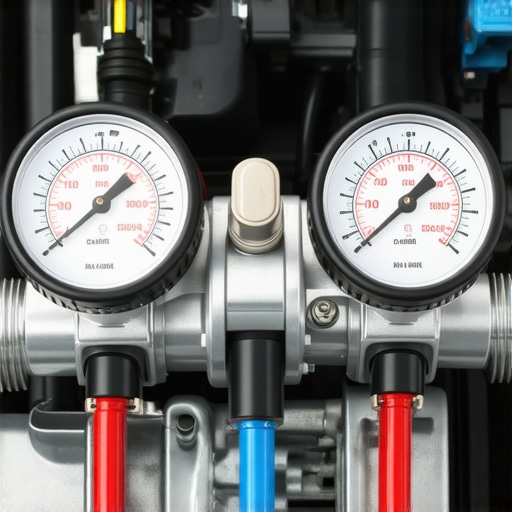
The $20 Can That Kills Your Compressor
I cannot stress this enough: avoid the “all-in-one” cans from the big-box stores. These often contain sealants that react with moisture and oxygen. The moment a technician opens your system to actually fix it, that sealant can harden, ruining thousands of dollars in shop equipment and your own car’s internals. It is far better to learn how to find a hidden coolant leak with a pressure tester and fix the actual seal than to glue the system shut from the inside.
The Hidden Heat Your Transmission Dumps into the AC
Here is a nuance most people miss: your car’s radiator, AC condenser, and transmission cooler are often stacked like a deck of cards. If your transmission is running hot, that heat radiates directly into the AC condenser, making it impossible for the AC to stay cold at idle. This is why I tell people to maximize your car’s lifespan with regular tune-ups that include checking all fluid levels. Understanding how transmission overhauls save you money in the long run isn’t just about the gears; it is about the thermal health of the entire front end. Sometimes, why your engine stalls when you turn on the ac is actually a result of the engine being overwhelmed by the sheer heat load of a struggling powertrain.
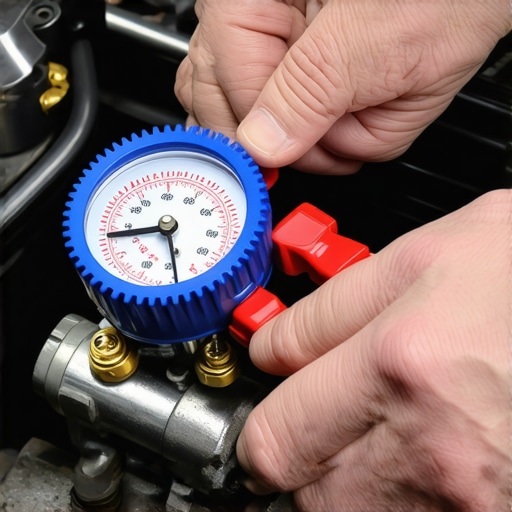
It is one thing to know your car is running hot, but it is another thing entirely to have the right tools to stop the guesswork. I spent years relying on those ‘dial of doom’ cans from the local parts store until I finally invested in a professional manifold gauge set. If you really want to maximize your car’s lifespan with regular tune-ups, you have to stop treating the AC like a mysterious black box. Those cheap gauges only show you the low-side pressure, which is only half the story. Without seeing the high-side pressure, you are essentially flying a plane with half a cockpit. You could be overcharging the system and blowing out your seals without even knowing it.
Get Real with a Manifold Gauge Set
The reason I recommend a manifold set is simple: balance. A healthy system should usually sit around 25-35 PSI on the low side and 200-250 PSI on the high side on a hot day. If your high side is spiking while you are at a stoplight, that is a dead giveaway that your condenser is clogged or your fan isn’t pulling enough heat away. This is where top signs your car needs expert auto repair now become incredibly obvious. According to Denso Aftermarket technical bulletins, a compressor failure is rarely the fault of the part itself; it is almost always the result of ‘slugging’—where liquid refrigerant enters the compressor because the system is overcharged or the heat exchange has failed. Denso notes that liquid is incompressible, and trying to squeeze it is the fastest way to turn your expensive compressor into a paperweight.
Stop Guessing and Start Reading the Data
Modern cars are essentially rolling computers, and they know a lot more about their AC system than they let on through the dashboard. When I am hunting for a phantom cooling issue, I don’t just look at the vents; I plug in a scanner to how to read live data to find a misfire or, in this case, check the AC pressure transducer voltage. If the computer sees the pressure is too high, it will cut the clutch to save the engine. This is a common culprit when people complain that their why your engine stalls when you turn on the ac or why the air suddenly cuts out during acceleration. If the electrical side is acting up, you should also take the time to learn how to diagnose a bad ground wire in minutes, because a weak ground can cause your cooling fans to spin at half speed, leaving you sweating in traffic while the temp gauge creeps up.
How do I keep my AC ice-cold for the long haul?
Long-term AC health is about two things: cleanliness and exercise. First, change your cabin air filter every 15,000 miles. A clogged filter restricts airflow over the evaporator core, which can cause it to freeze into a block of ice, effectively blocking all air from reaching your face. Second, run your AC for at least ten minutes once a month, even in the dead of winter. This keeps the internal seals lubricated with the oil that circulates with the refrigerant. Looking ahead, the industry is moving toward R-1234yf refrigerant and complex heat pump systems found in EVs, which are even more sensitive to debris. If you stay on top of the essential car service tips for safe summer drives today, you will be well-prepared for the more technical systems of the future. I challenge you to go outside right now and try the ‘cardboard test’ on your front grille—it is the easiest way to see if your fans are actually doing their job before the next heatwave hits.
Three Hard Lessons from a Career Spent Chasing Cold Air
Over the years, I have realized that the most frustrated drivers are those who throw money at the wrong end of the wrench. If there is one thing I want you to take away from my years of sweat-soaked diagnostics, it is that silence is your biggest red flag. If you come to a stop and your engine bay doesn’t sound like a jet taking off, your cooling fans are likely failing you. I have seen countless people replace perfectly good compressors when all they really needed was a simple relay or a better ground. You can quickly learn how to diagnose a bad ground wire in minutes to avoid this trap. Another vital lesson: your AC is not a standalone island. It shares its ‘breathing space’ with the rest of the car. If your transmission is running hot, your AC will suffer too. This is why understanding how transmission overhauls save you money in the long run is about more than just gears; it is about keeping the entire engine bay cool enough for your AC to do its job. Finally, never trust a single-dial DIY kit. Those ‘death cans’ are the fastest way to turn a minor leak into a total system meltdown.
The Only Tools You Actually Need to Stop the Sweat
You do not need a shop full of equipment to keep your cabin frosty, but you do need the right data. I recommend every DIYer keep an infrared thermometer in their glovebox. By measuring the temperature at the vents versus the ambient air outside, you can tell exactly how hard your system is working. If you find your why your engine temperature fluctuates while driving alongside the AC issues, you know you have a systemic cooling problem. I also swear by a soft-bristled fin comb to straighten out those delicate aluminum fins on the condenser that get flattened by road debris over time. Most importantly, stay proactive; knowing the top signs your car needs expert auto repair now can save you from a $2,000 bill later this summer. A little bit of knowledge and a few basic tools will keep you from being at the mercy of the elements.
Don’t Let a Red Light Ruin Your Summer
Fixing your car’s climate control is about reclaiming your peace of mind. There is no reason to dread every traffic light or parking lot. By focusing on airflow and system pressure instead of just adding more chemicals, you are doing the best thing possible to maximize your car’s lifespan with regular tune-ups. When your car performs properly at a standstill, you know the entire cooling system is healthy and ready for the long haul. Proper auto repair doesn’t have to be a mystery or a financial burden if you take it one step at a time. Have you ever been stuck in a ‘dashboard sauna’ at a long light? Let me know what your thermometer read in the comments below!