I remember standing over the hood of my old truck, steam billowing out like a Victorian locomotive. I felt like a total failure. I had just spent my entire Saturday morning following essential car service tips for safe summer drives, yet here I was, stranded. I had replaced the thermostat, thinking I was clever, but the engine was still baking. It is a visceral kind of frustration—grease under your fingernails, the smell of burnt coolant, and the realization that you have been chasing ghosts. I was convinced I would have to pull the whole radiator out just to see if it was blocked. I was wrong, and honestly, I wasted a lot of time and money before I figured out the easier way. Today, I am going to save you that headache. We are going to talk about how to pinpoint a blockage without a single bolt being turned. If your car has been acting up, maybe you have noticed why your engine temperature fluctuates while driving and it is starting to make you nervous. You do not need a degree in mechanical engineering, just a little bit of patience and a willing hand. Have you ever had that sinking feeling when the temp gauge starts climbing and you are miles from home? I have been there more times than I care to admit.
Stop Guessing and Start Feeling for Temperature Drops
The biggest mistake I made early on—and trust me, I have made plenty—was assuming that if the hoses were hot, the radiator was working. I once replaced a perfectly good water pump because I did not understand how cold spots worked. It was an expensive lesson in humility. The truth is, a radiator does not usually clog all at once. It happens in patches. Think of it like a clogged artery; fluid still flows, but not enough to keep the engine happy. According to the Car Care Council, cooling system failure is the leading cause of engine-related breakdowns on the highway, many of which are completely preventable. Most of these could be caught with a simple visual and physical check. If you have ever wondered why the $10 tool that saves your engine from overheating is so highly recommended, it is because it lets you see things your eyes cannot. But even without that tool, we can get a solid answer.
Can you really trust a no-tools diagnosis?
It sounds a bit like magic, does it not? Diagnosing a heavy-duty metal component without taking it to a shop? People are often skeptical because they have been told car repair is a dark art meant only for professionals. But I am here to tell you that your own senses are better than half the sensors on your dashboard. We are going to use a simple temperature differential check and a visual inspection of the coolant flow to see what is really going on inside those fins. It is about being proactive before you end up needing an expert auto repair. I want to help you gain the confidence to know exactly what is happening under your hood before you spend a dime at a garage.
Feel the Heat to Find the Clog
I have spent too many hours staring at a temperature gauge, praying it would drop, only to realize I was looking at the wrong part of the engine. The most effective way to diagnose a blockage is by using your hands to map out the heat across the radiator core. When a radiator is healthy, the heat is uniform across the fins. I remember working on a neighbor’s sedan that would overheat only on the highway. I ran my hand—carefully, mind you—across the radiator fins after a short drive. The top was scalding, but the bottom left corner was stone cold. That is the classic sign of sediment buildup. This is often why your engine temperature fluctuates while driving; the coolant is only using half the radiator surface area. By identifying these ‘dead zones,’ you can confirm a clog without needing a shop to run a flow test. If the entire bottom half of your radiator feels cool while the top is hot, you have found your culprit.
Scan for Cold Spots Across the Core
Wait until the engine has been running for about ten minutes and then turn it off. This is crucial—do not do this while the fan is spinning. Gently move your hand near the surface of the radiator fins from top to bottom and side to side. You are looking for a sudden drop in temperature. In my old truck, I found a ‘V’ shaped cold patch right in the center. It turned out to be years of neglected coolant crystallization. This kind of proactive checking is exactly how you maximize your cars lifespan with regular tune-ups. If you feel a drastic difference, the internal tubes are likely restricted, preventing the hot coolant from circulating through the cooling fins efficiently.
Watch the Flow Inside the Tank
If the hand test is inconclusive, you need to see if the fluid is actually moving. Wait until the engine is completely cold—never open a hot radiator—remove the cap, and then start the car. As it reaches operating temperature, the thermostat opens and you should see the coolant swirling or moving rapidly through the tubes. If it looks like a stagnant pond even when the engine is warm, you might have a dead pump or a massive internal blockage. I once had a car where the coolant stayed perfectly still, and it turned out the radiator was so full of ‘stop-leak’ gunk that it had turned into a solid block. This is a clear signal that you might need expert auto repair before you warp a cylinder head.
Check the Fan Response
Sometimes the radiator isn’t the problem at all, but the airflow is. If your car stays cool while moving but boils over at a red light, listen for the fan. If it is screaming constantly, you might be wondering why your radiator fan wont stop running. It is often trying to compensate for a core that cannot shed heat because the fins are packed with road debris or the internal flow is too slow. I once missed a simple blown fan fuse and almost replaced a whole radiator—don’t be like me. Always check if the air is actually being pulled through the core before you blame the metal. A radiator that is hot all over but still overheating usually points to an airflow issue rather than a blockage.
The Flush Myth That Might Cost You a Head Gasket
Everyone tells you to just ‘flush it out’ when things get hot. In my early days, I spent a small fortune on ‘heavy-duty’ chemical flushes, thinking they would magically dissolve years of neglect. But here is the reality: if your radiator is already showing those cold spots we talked about, a chemical flush is often too little, too late. According to the National Institute for Automotive Service Excellence (ASE), once a radiator core has significant internal scaling, the chemicals often cannot penetrate the center of the blockage. Worse yet, in older systems, that scale might be the only thing holding a weak seam together. I have seen enthusiasts flush a radiator only to have it start leaking from five different places twenty minutes later. If you are dealing with a truly neglected system, you have to accept that cleaning isn’t always fixing. This is part of how you maximize your cars lifespan with regular tune-ups—by knowing when a part is past the point of no return.
Why does the temp gauge only spike on steep hills?
This is a question I get all the time from people who think their radiator is ‘mostly fine.’ They can drive around town all day without an issue, but the moment they hit the highway or try to tow a trailer, the needle climbs. This indicates a ‘flow capacity’ issue. Your radiator might have enough clear tubes to handle the heat of a literal crawl, but it lacks the surface area to shed heat when the engine is under a heavy load. It is a nuanced failure that often gets misdiagnosed as a bad thermostat. I once spent three days chasing a ‘ghost’ overheat on a truck that only happened on one specific bridge. It turned out the radiator was about 30% blocked—not enough to kill it at idle, but enough to fail when the engine actually had to work. If you are seeing this, it is time to how to find a hidden coolant leak with a pressure tester or check for internal flow restrictions before you find yourself needing expert auto repair on the side of a mountain.
Don’t Fall for the Stop-Leak Siren Song
If there is one ‘trap’ I want you to avoid at all costs, it is the ‘magic in a bottle’ stop-leak products. I know the marketing is tempting when you see a small drip, but these products are the ultimate radiator killers. They do not know the difference between a hole in your tank and the tiny, narrow cooling tubes in your heater core or radiator. I have torn down engines where the entire cooling jacket was gummed up with what looked like metallic oatmeal because of a $10 bottle of sealant. It is a temporary fix that creates a permanent, expensive problem. If you are worried about your cooling system’s health, you are better off learning how to read live data to find a misfire or cooling spike through an OBDII scanner rather than pouring goop into your reservoir. Have you ever fallen into this trap and regretted it later? Let me know in the comments. It’s better to replace a $150 radiator now than a $4,000 engine next month. It all comes back to essential car service tips for safe summer drives; being honest about the condition of your parts is the only way to stay on the road.
Grab an Infrared Thermometer to See the Invisible
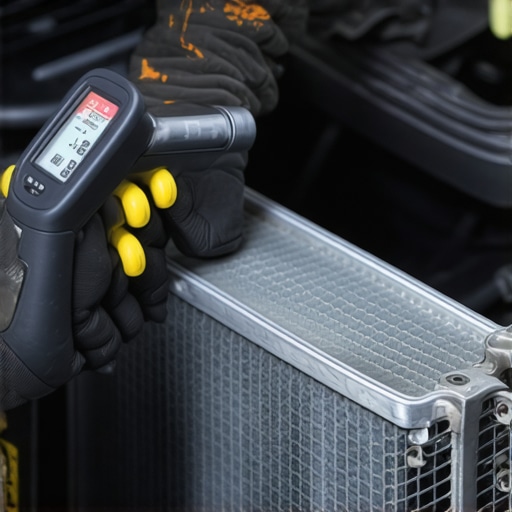
I stopped relying on my dashboard gauge years ago. That needle is often a ‘buffered’ signal, meaning by the time it moves toward the red, the damage is already starting. This is why the $10 tool that saves your engine from overheating—a non-contact infrared (IR) thermometer—is the first thing I grab. I use it to map the entire surface of the radiator core while the engine is at operating temperature. If I see a 30-degree drop in one specific corner, I know exactly where the sediment has settled. It takes the guesswork out of the equation and gives you data that even a master mechanic would envy. When you can pinpoint a failure before it leaves you stranded, you are actually taking control of your vehicle’s health rather than just reacting to its failures.
How do I maintain my cooling system over the long haul?
The secret isn’t just about topping off fluids; it is about chemistry. According to the Society of Automotive Engineers (SAE) in their J1034 technical documentation, the precise chemical balance of modern engine coolant is designed to inhibit cavitation—tiny air bubbles that can erode metal surfaces—which is why using the wrong fluid or mixing brands is such a massive gamble. To maximize your cars lifespan with regular tune-ups, you should be testing your coolant’s pH levels once a year. If the fluid becomes too acidic, it begins to eat your gaskets from the inside out. I personally use a simple set of litmus strips that cost next to nothing but tell me exactly when the corrosion inhibitors have been depleted. It is a three-minute check that has saved me from replacing three different water pumps over the last decade.
Why Your Transmission Depends on Your Radiator
Many drivers don’t realize that their radiator is actually a multi-tasker. In most automatic vehicles, there is a separate heat exchanger inside the radiator tank specifically for your transmission fluid. If the radiator becomes clogged or the internal walls fail, you risk ‘strawberry milkshake’ syndrome—where coolant and transmission fluid mix. This is a death sentence for your gears. Monitoring the health of your cooling system is directly linked to how transmission overhauls save you money in the long run. If you notice your car struggling to get into gear or if why your transmission slips when the engine is cold becomes a frequent concern, check your radiator first. A small internal leak can destroy a $3,000 transmission in less than twenty miles. If you see milky fluid on your dipstick, do not start the car; it is one of the most urgent top signs your car needs expert auto repair now.
Thermal Management in the Age of Electric Cars
Looking ahead, the ‘traditional’ radiator isn’t going away, but it is evolving. As we move toward more hybrid and electric vehicles, thermal management is becoming even more complex. We are seeing multi-stage cooling loops that handle batteries, motors, and cabin heat all at once. In the future, I predict we will see even more integrated sensors that can detect specific flow restrictions in real-time, sending an alert to your phone before you even feel a vibration. But for now, the old-school methods still reign supreme. I want you to try this: go out and buy a cheap non-contact IR thermometer and map your radiator after your next commute. Seeing the ‘thermal footprint’ of your car for the first time is a total game-changer for any DIY enthusiast.
It is easy to feel powerless when your car starts running hot, but after years of trial and error, I have learned that a little intuition goes further than a box of expensive sensors. You do not need a shop to tell you your car is struggling; you just need to know which signs to respect and which myths to ignore.
Hard Lessons Bought with Sweat and Burnt Fingertips
The most expensive mistake I ever made was trusting a dashboard gauge over my own gut. I once ignored a slight temperature fluctuation because the needle stayed just shy of the red zone, only to find out later that the radiator core was half-full of sludge. Never assume a ‘normal’ reading means a healthy system. If you feel a loss of power or hear the fan working overtime, believe the car, not the computer. I also learned the hard way that ‘universal’ coolants are rarely universal; mixing the wrong types can lead to a gel-like buildup that mimics a total blockage. Lastly, always ‘burp’ your system after a flush. A trapped air pocket can feel exactly like a clogged radiator, causing localized overheating that will eventually lead you to search for expert auto repair when you could have fixed it with a simple bleed valve.
My Survival Kit for Preventing Cooling Disasters
While we focused on a no-tools approach, there are three items I never travel without to ensure my cooling system stays in peak condition. First, the $10 tool that saves your engine from overheating is the infrared thermometer I mentioned earlier; it is the only way to see the invisible heat map of your engine. Second, a simple pack of pH test strips allows me to check if my coolant has turned acidic before it starts eating my gaskets. Finally, I always keep a link to a guide on how to find a hidden coolant leak with a pressure tester, because a blockage and a leak often share the same symptoms. These tools don’t just fix problems; they provide the peace of mind that comes with knowing exactly what is happening under your hood.
Take the Wheel and Forget the Overheating Anxiety
You now have the knowledge to diagnose one of the most common engine killers without spending a dime at a shop. By using your hands to feel for cold spots, watching the coolant flow, and listening to your fan’s behavior, you are practicing the most essential car service tips for safe summer drives. Do not let the complexity of modern cars intimidate you. At the end of the day, it is still just heat, fluid, and airflow. The more you pay attention to the small changes, the better you will be at avoiding the big breakdowns. Have you ever felt a ‘cold spot’ on your radiator only to realize it was the key to solving a mystery overheat? Let me know in the comments below!