
I remember sitting in gridlock on a Tuesday, the kind of heat that makes the asphalt shimmer like a lake. I glanced down, and my heart skipped. The needle on my temp gauge wasn’t just sitting there; it was twitching. Up, down, then back up again. I felt that cold sweat. Was I about to be the guy on the shoulder with a plume of white smoke? Look, I’ve been there. I actually ignored a similar ‘glitch’ in my old truck for a week, thinking it was just a moody sensor, only to realize I was dealing with a slow leak from a $15 gasket that eventually cost me a weekend of labor. Today, I want to help you decode those annoying fluctuations before they turn into a full-blown auto repair nightmare. We’re going to figure out why your gauge is acting like a yo-yo and exactly how to fix it without getting fleeced. Knowing what to look for can save you from a major breakdown during safe summer drives when the heat is punishing. It isn’t just about the ‘now’; it’s about making sure you don’t end up needing a massive transmission overhaul because the engine got too hot and cooked the fluid nearby.
Stop Staring at the Needle and Start Acting
The truth is, your engine’s temperature should be as steady as a heart surgeon’s hand once it warms up. If it’s jumping every time you hit a red light or climb a hill, your cooling system is trying to tell you a secret, and usually, it’s not a good one. Many folks think they need a whole new radiator, but often it’s just a simple $10 tool or a quick flush that solves the problem. I once spent hundreds on a new pump only to find out a radiator fan was the real culprit. According to AAA, cooling system failure is a leading cause of mechanical breakdowns in the summer, often triggered by neglected maintenance or simple component fatigue. You don’t want to wait until you see steam; you want to catch the ‘fever’ while it’s still just a sniffle. If you let it go, you might find yourself looking for an honest mechanic to bail you out of a head gasket replacement. Have you ever noticed your gauge move and just hoped it was a one-time thing? It rarely is. Tell me about it in the comments—I’ve likely made the same mistake you’re worried about!
Is my car actually going to blow up in traffic?
It’s the fear we all have, right? That the fluctuation is just the final warning before a catastrophic engine meltdown. While modern engines are tough, they aren’t invincible. Consistent heat spikes warp heads and fry gaskets faster than you’d think. A little proactive regular tune up can prevent these spikes from becoming permanent damage. If your car is blowing warm air at a stoplight while that needle climbs, you’ve got a specific type of airflow problem we need to tackle immediately. Even if your car won’t go in reverse when things get spicy under the hood, there is usually a logical explanation that doesn’t involve a total vehicle loss. We’re going to dive into the specifics of thermostats, fans, and air pockets next, so you can stop white-knuckling the steering wheel every time the light turns red.
Flush Out the Air Pockets First
Most people assume a jumping needle means a broken part, but many times it’s just air trapped in the system. Think of your cooling system like a straw; if there is a big bubble in the middle, you aren’t getting any soda. I once spent three hours chasing a ‘bad’ radiator on a client’s car, only to realize there was a massive air bubble trapped behind the thermostat. I used a $10 tool—a spill-proof funnel—and the problem vanished in ten minutes. To fix this yourself, you need to ‘burp’ the system. Park on an incline with the nose of the car pointing up, remove the radiator cap (only when cold!), and let the engine run. As it warms up, the air bubbles will rise to the highest point—the radiator neck—and escape. This is a critical part of a regular tune up that prevents ‘phantom’ overheating.
Stop the Ghost in Your Thermostat
The thermostat is the bouncer of your engine’s cooling system. It stays closed until the engine is hot enough, then it swings open to let coolant flow. If it’s sticking, your needle will dance as the valve struggles to move. You can test this by feeling the upper radiator hose while the engine is running (carefully!). If the engine is hot but the hose is cold, that bouncer isn’t letting anyone into the club. Replacing this is usually cheap and prevents you from needing a major auto repair later. A failed thermostat is a common reason why your car struggles to climb hills without the temp gauge pegging to the right.
Why Your Fan Matters at Red Lights
If your temperature only climbs when you’re sitting still, your radiator fan is likely the culprit. When you’re driving, the wind does the cooling for you. When you stop, that fan has to kick in. If it doesn’t, you’ll notice your AC blows warm air because the condenser isn’t getting cooled either. Checking the electrical connector for corrosion is a quick win that saves you from a full transmission overhaul caused by extreme engine bay heat.
Identify the Fluid Quality Immediately
Open that cap and look at the color of your coolant. If it looks like a muddy mess, you might have an internal leak. Coolant that looks like chocolate milk is a massive red flag for a blown head gasket. In that case, ignoring it could lead to a situation where your car won’t go in reverse because the excessive heat has warped internal components or thinned out the transmission fluid. Regular maintenance and car service checks are your best defense against these thermal gremlins. Catching a leaking gasket early through visual inspection saves you thousands in the long run.
Most shops will tell you that a ‘universal’ coolant works for every make and model. That is a flat-out lie that often leads to expert auto repair bills you didn’t budget for. According to the Society of Automotive Engineers (SAE), mixing Organic Acid Technology (OAT) with traditional Inorganic Acid Technology (IAT) can cause the fluids to react and form a thick gel. This ‘jelly’ doesn’t just block flow; it acts as a thermal insulator, trapping heat inside the engine block while your gauge reads perfectly normal. I’ve seen engines destroyed because a DIYer topped off their system with the wrong color during a regular tune up. It’s a classic trap that even some experienced mechanics fall into because they trust the label on the bottle rather than the manufacturer’s spec.
The Electrical Ghost in Your Dashboard
Sometimes the problem isn’t mechanical at all, but rather a hidden ground strap that causes weird electrical ghosts. If that ground wire is frayed, the sensor sends erratic voltage to the gauge, making it jump like a heart monitor. I once spent three days chasing a cooling issue on a vintage sedan only to realize a ten-dollar wire was the real culprit. It’s a nuance that separates a parts-changer from a real diagnostic pro. If you’ve been replacing parts and the needle is still twitching, stop looking at the fluid and start checking your wires. Have you ever fallen into this trap? Let me know in the comments!
What if the needle stays level but I smell burning?
This is the most dangerous scenario for any driver. If your gauge is rock steady but you smell that sweet, sickly scent of hot antifreeze, you likely have a ‘dry’ sensor. If your coolant level drops below the sensor itself, it has nothing to measure but air, which doesn’t transfer heat as well as liquid. Your car could be melting down while the gauge claims everything is fine. This is why safe summer drives require a physical check of the reservoir, not just a glance at the dash. Ignoring a small leaking gasket because ‘the gauge looks okay’ is the fastest way to turn a minor fix into a transmission overhaul due to extreme secondary heat. Don’t trust the electronics blindly; trust your nose and your eyes under the hood.
I’ve spent years under hoods, and if there is one thing I’ve learned, it’s that your dashboard is often a liar. Most modern gauges are ‘dampened’ by the factory—meaning the needle stays perfectly centered even if the temperature fluctuates by 15 or 20 degrees—purely to keep drivers from panicking. To really see what is happening under the surface, you need to step up your game. I personally rely on a high-quality infrared thermometer to verify what the sensors are claiming. I use mine to map out ‘cold spots’ in the radiator core. If one section of the fins is significantly cooler than the rest while the engine is hot, you’ve found a internal blockage. This is the kind of pro-level regular tune up insight that prevents a surprise expert auto repair bill. According to technical bulletins from the AERA Engine Builders Association, thermal mapping is the only reliable way to detect localized ‘hot spots’ in the cylinder head before the aluminum begins to warp and lose its structural integrity. Pair this mapping with a digital multimeter to find a parasitic battery drain that might be secretly weakening your electric fan’s relay performance during those safe summer drives. 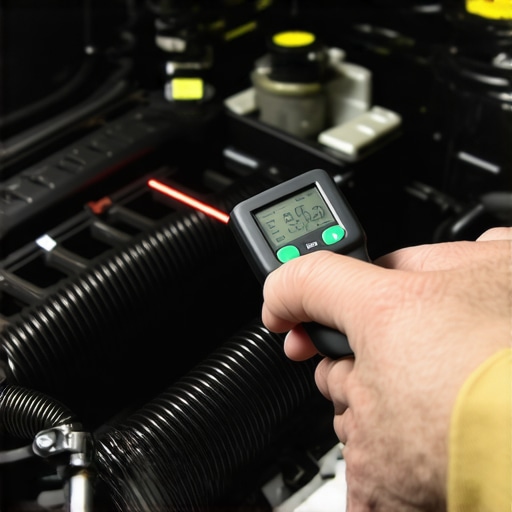
How do I keep my cooling system healthy for another 100k miles?
The secret isn’t just changing the fluid; it is the method of the refill. Traditional pouring always leaves tiny pockets of air that lead to hot spots. I started using a vacuum coolant refiller years ago, and I’ll never go back. It’s essentially the ‘pro’ version of the $10 tool I mentioned earlier. It sucks the entire system into a vacuum, collapsing the hoses, and then uses that negative pressure to pull the new coolant into every tiny crevice of the heater core and block. This ensures your engine is 100% liquid-filled from the first second of startup. If you’re still chasing mystery drips, check the leaking gasket at the thermostat housing or the bypass pipe first. Most people jump to the water pump because it’s expensive and obvious, but these smaller seals fail far more often due to the constant expansion and contraction of heat cycles. For those living in extreme heat, finding an honest mechanic in Yuma who specifically understands the desert’s impact on plastic ‘quick-connect’ fittings is vital. These plastic bits become brittle like crackers and can snap without warning, causing an instant meltdown that leads to a transmission overhaul when the integrated cooler fails. Looking ahead, I predict we are moving toward fully decoupled electric cooling modules that operate independently of engine RPM. This will make your cooling much more efficient, but it also makes digital diagnostics even more critical. My advice? Go out to your driveway tomorrow, let the car reach operating temperature, and hit the upper and lower radiator hoses with an IR thermometer. If the difference is less than 20 degrees, your radiator might be losing its heat-exchange efficiency—catch it now while it’s a cheap fix!
The Expensive Lessons I Paid for in Blown Gaskets
After decades of turning wrenches, I’ve realized that the most dangerous thing a driver can do is assume a ‘small’ fluctuation is an isolated incident. I once watched a needle dance for three days, telling myself it was just a loose wire, only to find out that a small rattle was actually a failing water pump pulley. If I had known how to fix a rattling heat shield for free, I might have spent more time listening to the actual engine noise rather than being distracted by a loose piece of metal. Another lightbulb moment for me was realizing that your engine’s grounding is just as important as the coolant itself; a bad ground can turn a perfectly healthy car into a diagnostic nightmare. Lastly, never underestimate the power of a clean engine bay. It’s not just for looks—it helps you spot the dried crusty remains of a slow coolant leak before it becomes a gusher.
The Tools I Trust to Keep My Dash Calm
You don’t need a professional shop to keep your car healthy, but you do need more than a prayer and a pair of pliers. My personal toolkit always includes a Bluetooth OBDII scanner. This allows me to see the raw digital temperature data on my phone, which is far more accurate than the ‘dampened’ needle on your dashboard. I also swear by my laser-guided infrared thermometer for mapping out radiator efficiency. When it comes to fluids, I only use manufacturer-specific coolant; the ‘universal’ stuff is a gamble I’m no longer willing to take. If you’re doing your own maintenance, knowing how to remove a stuck oil filter without a specialized wrench can save your Saturday, and having a quality spill-proof funnel is the difference between a clean driveway and a sticky mess.
#IMAGE_PLACE_HOLDER_E#
Reclaim Your Peace of Mind on the Road
Walking out to your car shouldn’t feel like a roll of the dice. By paying attention to those subtle twitches of the needle and acting on them early, you are taking the single most effective step toward a long-lasting vehicle. Whether you are handling a DIY regular tune up or looking for red flags when choosing an Albuquerque mechanic, being an informed owner is your best defense against predatory pricing. Your car is a complex machine, but it’s one that rewards attention. Take care of your cooling system, and it will take care of you, ensuring many more miles of safe summer drives. You’ve got the knowledge now—it’s time to use it. Have you ever had a temperature gauge scare that turned out to be a simple fix? Let me know in the comments below!