
I’ll never forget the sound of my bumper meeting a concrete pole in a Target parking lot. It was a slow, agonizing crunch that made my stomach do a backflip. I jumped out, expecting a disaster, but to my surprise, there was just a tiny scratch on the plastic. I breathed a sigh of relief, hopped back in, and went about my day. Big mistake. About three weeks later, my truck started eating through front tires like they were made of butter, and I realized that my “minor” bump had actually tweaked the structure underneath. It was a hard lesson to learn, but it taught me that what you see on the outside of your car is rarely the whole story.
Why a Low-Speed Tap Is Often More Than Meets the Eye
Most people assume that if the airbags didn’t go off and the radiator isn’t leaking, the car is perfectly fine. I used to think the same way until that parking lot incident taught me better. Modern cars are designed with “crumple zones,” which are amazing for keeping us safe, but they are incredibly sensitive. Even a 5-mph impact can transfer enough energy to shift the metal skeleton of your vehicle. Think of it like your own body; you might look fine after a fall, but a hairline fracture in your leg is going to change the way you walk. Cars are the same. If the frame is out of whack by even a fraction of an inch, the geometry of your entire suspension is compromised. If you’ve noticed that your steering wheel shakes when you hit the brakes or your steering feels loose on the highway, don’t ignore it. I made the mistake of waiting until I needed two new tires to take it seriously. It turns out, you can often spot a bent frame without a measurement rack if you know exactly where to look for those subtle misalignments in body panels and door gaps. Ignoring these signs doesn’t just cost you tires; it can drastically shorten your vehicle’s life, whereas a quick tune-up and alignment check could have saved me thousands.
Can a Car Really Be Totaled by a Simple Fender Bender?
It sounds dramatic, doesn’t it? But here is the reality: your car’s frame is its foundation. According to data from the National Highway Traffic Safety Administration, structural integrity is the single most important factor in how a vehicle performs during a secondary collision. If the frame is already compromised, it won’t protect you the way it was designed to. This is why getting an expert auto repair assessment immediately after any impact is vital. I’ve seen so many folks try to DIY their way out of a collision repair, only to end up with a car that’s fundamentally unsafe. My goal today is to help you look past the shiny paint and see if the bones of your ride are still straight. We are going to dive into the physical “tells” that your car is trying to give you. Have you ever felt like your car was “crab-walking” down the road after a small hit? Tell me your story in the comments—I’d love to hear how you handled it.
Perform a Quick DIY Structural Audit
You don’t need a laser-guided measurement rack to find the big red flags. Think of your car’s frame like a house foundation; if it shifts, the doors won’t close right. Start by walking around the car and checking the gaps between body panels—the hood, doors, and trunk. These gaps should be uniform. If a gap is wider at the top than the bottom, the metal underneath has likely moved.
The Wheelbase Measurement Trick
I remember helping a neighbor who had just tapped a curb in his sedan. He laughed when I pulled out a simple tape measure, but his face went pale when the driver’s side wheelbase was nearly an inch shorter than the passenger side. To do this, find a flat surface and measure from the center of the front wheel to the center of the rear wheel on both sides. They should be identical. If they aren’t, your frame is diamonded or your suspension is pushed back. You can often spot a bent frame without a measurement rack just by being precise with a tape. 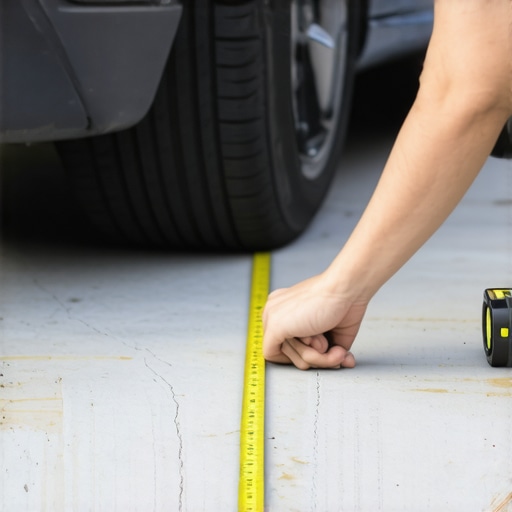
Check for Fluid Leaks and Cracks
Get underneath the car with a flashlight. You are looking for more than just oil. Look at the kinks in the frame rails. Manufacturers often put small holes or notches in the frame as crush points. If the paint is flaking off or the metal looks accordion-like, that is a clear sign of impact absorption. While you are down there, inspect the rubber boots. If you see grease spraying, you might be looking at the sign your ball joints are about to snap or a compromised CV axle.
Listen for Ghost Vibrations During Your Test Drive
Take the car to a quiet, flat road. If the reason your car shakes when you accelerate started only after the bump, something is out of balance. A bent axle or a shifted transmission mount can cause a rhythmic vibration that feels like a heartbeat through the floorboard. If the car pulls to one side, your alignment is gone, which is one of the top signs your car needs expert auto repair now. I once ignored a slight hum after a minor hit, thinking it was just road noise, only to find out a wheel bearing had been flat-spotted by the force of the impact.
The Visual Warning Signs of Suspension Stress
Check your tires. If you see feathering, where the tread feels smooth in one direction but sharp in the other, your toe-in is off. This is why regular maintenance is key; you can maximize your car’s lifespan with regular tune-ups and alignment checks that catch these issues before they ruin an expensive tire. If the car sits lower on one corner or bounces like a pogo stick when you push down on the fender, the shock or strut took the brunt of the hit. Don’t assume the internal damage is minor just because the bumper popped back into place.
Stop Believing Your Transmission Fluid is Forever
Most dealerships will look you straight in the eye and tell you your transmission fluid is a “lifetime” fill. In my experience, that’s the fastest way to a $4,000 repair bill. Heat is the ultimate enemy of gears, and even the best synthetic oil breaks down after 60,000 to 100,000 miles. When you buy into the “no maintenance” myth, you’re essentially setting a timer on your car’s death. I’ve seen it time and again: owners think they are following the manual, but they end up searching for how to tell if a transmission shop is lying about a rebuild because their “lifetime” fluid turned into sludge. Always check the truth about lifetime gearbox fluids before assuming your car is maintenance-free.
Can a Micro-Shift Disable Your Safety Features?
Modern cars are basically rolling computers, and this is where most people get caught in the “it looks fine” trap. If you had a minor bump and now the subtle error that makes your cars automatic braking too sensitive is driving you crazy, it is probably not the software. It’s the hardware. A frame that is off by just 2 millimeters can angle a radar sensor toward the pavement or the sky. The Society of Automotive Engineers (SAE) notes that sensor calibration is now as critical as structural welding in modern collision repair. If your shop isn’t talking about ADAS recalibration after a frame pull, they are stuck in 1995. 
The Ghost in Your Electrical System
This is what I call the “ghost in the machine.” Often, the most frustrating post-collision issues aren’t the frame or the tires, but the hidden ground wire that ruins your sensors. Vibrations from a small impact can loosen a ground strap, leading to erratic shifting or weird dashboard lights. People often dump money into a new battery or alternator, but they’ve actually fallen into the one electrical fault that most mechanics misdiagnose as a dead battery. Always check the simple connections before you let someone tear into your drivetrain or perform a costly transmission overhaul. Have you ever spent a fortune on a part only to find out it was a $5 fuse or a loose wire? Let me know in the comments—I’ve definitely been there.
Equip Your Garage Like a Professional
I spent way too many years swapping out parts based on a hunch before I realized that the pros don’t guess—they measure. If you want to move beyond basic oil changes, you need a bi-directional OBD-II scanner. Unlike those cheap readers that just clear a check engine light, a bi-directional tool lets you talk back to the car. I used mine last week to manually cycle a fuel pump and troubleshoot a stalling issue without tearing the seat out. Being able to command your vehicle to perform self-tests is the ultimate cheat code for home repair. It is also the only way to know if why your AC blows warm air while sitting in traffic is a mechanical failure or just a computer-controlled fan refusing to kick on. Another non-negotiable tool is a high-quality digital multimeter. Most people think they are only for batteries, but I use mine to hunt down ground issues that cause those ‘ghost’ electrical problems we talked about. Learning how to find a parasitic battery drain with a simple multimeter can save you from buying three alternators you don’t actually need. 
How do I keep my high-mileage car reliable for the long haul?
Maintenance isn’t just about the 3,000-mile oil change anymore; it is about the big milestones. To truly protect your investment, you have to look at the rubber and the fluids that everyone else ignores. Bushings, vacuum lines, and coolant hoses start to get brittle after seven or eight years. I personally do a ‘deep dive’ inspection every spring, looking specifically for small cracks in the intake or leaks in the power steering lines. If you are approaching six figures on the odometer, you need to know how to save money on your 100k mile service by sourcing your own high-quality parts and doing the labor-intensive inspections yourself. It is also the perfect time to review essential car service tips for safe summer drives, because heat will find the weakest link in your cooling system faster than anything else.
The Software Shift You Need to Prepare For
The future of auto repair is moving away from the wrench and toward the laptop. The Auto Care Association recently highlighted that by 2030, nearly every new vehicle will be a ‘connected’ car, sending real-time health data back to the manufacturer. This shift toward telematics means that predictive maintenance will soon be the norm—your car will tell you that a bearing is going to fail 500 miles before it actually makes a sound. While this sounds great, it also means we have to fight for our right to access that data. If we lose the ability to read our own car’s telemetry, we become beholden to dealership prices for every minor calibration. My advice? Start getting comfortable with diagnostic software now. Whether it is using a dedicated laptop setup for your specific make or just a high-end mobile app, the more you know about your car’s data, the less you’ll pay in ‘diagnostic fees’ later. My challenge to you this weekend: Don’t just wash your car. Pop the hood, grab a multimeter, and check your battery’s resting voltage and your ground straps. It takes five minutes and could save you a massive headache next month.
The Hard Lessons I Learned While Chasing Ghost Vibrations
Looking back at my own mistakes, I’ve realized that the biggest trap you can fall into is believing a car is fine just because the body panels line up. Here are the lightbulb moments that changed how I approach every auto repair project: First, I learned that modern plastic bumpers are designed to hide sins. They can absorb a 5-mph impact and pop back into their original shape while leaving the steel reinforcement bar behind them crushed and useless. Second, never ignore a new vibration. If your car suddenly develops a hum or a shimmy, you aren’t imagining it—something has shifted or been flat-spotted. Third, the most expensive repairs usually start as the smallest ignored signs. A tiny hidden ground wire that ruins your sensors can trigger a cascade of dashboard lights that make a simple fix look like a total electrical failure. Lastly, I realized that keeping a schedule for a regular tune up is the only way to build the baseline knowledge of your car so you actually notice when something changes after a bump.
The Gear That Separates Mechanics from Guessers
If you want to stop paying for ‘exploratory labor’ at the shop, you need a few specific items in your corner. I swear by a bi-directional scan tool because it lets you test individual components like cooling fans or ABS pumps without taking anything apart. For electrical gremlins, a digital multimeter is your best friend. It’s the only way to accurately find a parasitic battery drain before you waste money on a new alternator. I also recommend keeping a digital copy of your car’s factory service manual rather than a generic third-party guide; the specific torque specs and wiring diagrams for your exact VIN are worth their weight in gold. These tools turn car service from a guessing game into a precise science.
Become the Expert Your Car Deserves
Taking care of your vehicle doesn’t require a degree in engineering, but it does require a shift in mindset. Whether you are investigating the top signs your car needs expert auto repair now or simply performing a 100k mile service, the goal is the same: stay ahead of the damage. Your car is a collection of systems that rely on each other. When you fix that minor frame misalignment or replace a failing sensor, you aren’t just repairing metal; you are preserving the safety and reliability that your family depends on every single day. Don’t be afraid to dig deep and ask the hard questions when you’re at the shop. What’s the one ‘mystery noise’ your car made after a minor accident that ended up being something totally unexpected? Let me know your detective stories in the comments below!