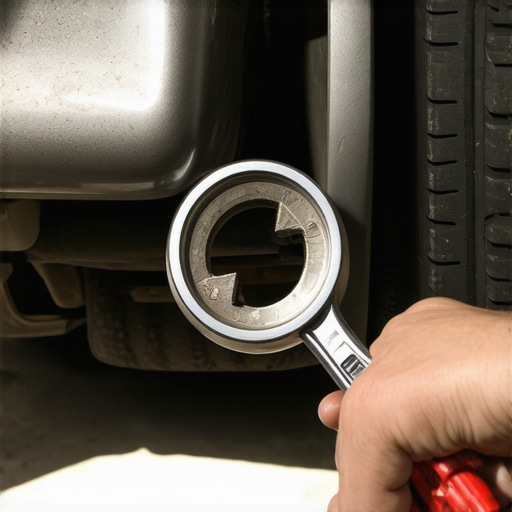
There I was, idling at a busy intersection in my favorite old sedan, when it started. *Tink-clank-rattle-tink.* It wasn’t a low rumble or a rhythmic thud; it sounded like a bag of aluminum cans was tied to my undercarriage. I could feel the eyes of every pedestrian on me. You know that look—the one that says, ‘Someone needs a trip to the junkyard.’ For a second, I panicked. Was it my transmission? I’d read about how [transmission overhauls save you money](https://collisionfixer.com/how-transmission-overhauls-save-you-money-in-the-long-run) in the long run, but I wasn’t ready for that bill today. It turns out, that obnoxious noise was just a loose piece of thin aluminum heat shielding. I almost spent three hundred dollars at a shop for a fix I eventually did in my driveway for zero dollars using a piece of scrap wire. Today, I’m going to show you how to identify this ‘phantom’ noise and secure it yourself without buying a single new part. My neighbor, Dave, actually thought his engine was toast last month for this exact same reason. He was ready to sell his truck for parts until I crawled under there with him and found the culprit. [IMAGE_PLACEHOLDER_1]
The Neighborhood Is Staring and Your Car Sounds Like Trash
It is incredibly frustrating when you take care of your vehicle, keep up with [regular tune-ups](https://collisionfixer.com/maximize-your-cars-lifespan-with-regular-tune-ups), and yet it still sounds like a bucket of bolts. Most people hear a metallic rattle and immediately fear the worst. They think of blown shocks or failing exhaust manifolds. I made that exact mistake years ago. I spent an entire weekend chasing what I thought was a [bad CV joint](https://collisionfixer.com/how-to-spot-a-bad-cv-joint-before-it-snaps) because the sound seemed to change with my speed. I was young, over-eager, and completely ignored the simplest explanation. The reality is that heat shields are often held on by thin nuts that eventually corrode and ‘pull through’ the aluminum. Once that hole gets too big, the shield just sits there dancing against your exhaust pipe. It’s loud, it’s annoying, and it makes your car feel cheap.
Does this noise mean my engine is about to explode?
Many drivers worry that a rattling heat shield is a precursor to a total engine failure. While it’s rarely that dramatic, it isn’t something to ignore forever. According to the National Fire Protection Association (NFPA), the heat generated by your catalytic converter can exceed 1,200 degrees Fahrenheit. Without that shield, that heat can soak into your floorboards or, worse, ignite dry grass if you park in a field. So, while your engine isn’t going to blow up, your comfort and safety are on the line. Have you ever had to turn up the radio just to drown out a mysterious metallic vibration? You shouldn’t have to live like that, especially when the fix is essentially free.
My Expensive Mistake and Why You Don’t Need a Mechanic Yet
Before you start looking for [expert auto repair](https://collisionfixer.com/top-signs-your-car-needs-expert-auto-repair-now), you need to perform the ‘tap test.’ I once paid a ‘diagnostic fee’ at a dealership just for a technician to tell me a $2 hose clamp would fix my rattle. I felt like a total amateur. The truth is, heat shields are thin, flimsy, and prone to road salt damage. Sometimes the noise is so specific it mimics [why your dashboard vibrates when the ac is on](https://collisionfixer.com/why-your-dashboard-vibrates-when-the-ac-is-on), making you think it’s an interior trim issue. But if the noise happens mostly at a specific RPM—usually around 2,000 to 3,000—or while idling at a light, it’s almost certainly the shield. Grab a pair of gloves and a flashlight. We are going to crawl under there and find the culprit. You don’t need a lift or a fancy set of air tools for this. If you can twist a piece of wire or tighten a screw, you can do this.
Locate the Source Without Getting Burned
Before you go diving under the chassis, you have to play it smart. Exhaust components are the hottest parts of your vehicle, often reaching temperatures that will melt skin instantly. Let the car sit for at least an hour. Once it is cool to the touch, put on some work gloves and use a flashlight to scan the length of your exhaust pipe. You are looking for thin, silver-colored panels that seem to be ‘hovering’ just above the pipe or the muffler. Give each one a firm poke or a wiggle. If it moves more than a fraction of an inch or makes a metallic clink, you’ve found your ghost. This is a great time to check other basics, as staying on top of regular tune-ups often reveals these small nuisances before they become road-side emergencies.
The Three-Cent Part That Saves Your Sanity
The most common reason these shields fail is ‘galvanic corrosion.’ The steel bolt and the aluminum shield react over time, and the hole in the aluminum essentially dissolves until it is larger than the bolt head. I remember my old 2004 truck; the shield was literally hanging by a thread, vibrating so loudly I thought I had a leaking power steering line spraying on the manifold. To fix this, you don’t need to replace the whole shield. You just need a larger surface area. Grab a handful of large fender washers from the hardware store. By unscrewing the original bolt and placing that massive washer over the enlarged, corroded hole, you effectively ‘sandwich’ the shield back into place. It’s a permanent fix for the price of a gumball.
The Stainless Steel Wire Wrap Method
Sometimes the bolt is so rusted that trying to turn it will snap the stud right off the car’s frame. If you hit it with penetrating oil and it still won’t budge, do not force it. Instead, use stainless steel safety wire or even a high-temperature metal hose clamp. I once spent three hours drilling out a snapped bolt on a friend’s SUV when I could have just looped a piece of wire around the bracket and the shield in five minutes. This ‘floating’ fix keeps the shield from touching the exhaust pipe, which stops the noise and prevents the heat transfer that explains why your engine temperature spikes while idling in heavy traffic.
When to Put the Tools Down and Call a Pro
While a rattle is usually just a loose shield, there are moments where you need to step back. If you crawl under there and notice the exhaust pipe itself is rusted through, or if the ‘rattle’ is actually coming from inside the catalytic converter, a washer isn’t going to help you. Internal rattles often mean the catalyst honeycomb has shattered, which can clog your exhaust and kill your engine. If you see heavy structural rust or signs of fluid leaks you can’t identify, that is one of the top signs your car needs expert auto repair now. Don’t be the person who wires up a failing exhaust pipe only to have it fall off on the highway. Secure the shield, check your work, and enjoy the silence of a car that no longer sounds like it’s falling apart.Most ‘pros’ will tell you that modern transmissions are sealed for life. This is the single biggest trap in the automotive world today. In my experience, ‘lifetime’ usually means ‘the life of the warranty,’ not the life of the car. If you want to avoid a massive bill, checking the truth about lifetime gearbox fluids is a non-negotiable part of your maintenance routine. Heat breaks down everything, and if you are towing or driving in stop-and-go traffic, that fluid is cooking. I have seen dozens of transmissions fail at 120,000 miles because the owner believed the marketing fluff. Then there is the ‘parts cannon’ trap. This is where you replace every sensor because a code popped up on your dash. I once saw a guy replace his entire fuel system when he actually had a hidden ground strap causing weird electrical ghosts. He spent two grand on parts he did not need because he did not check the electrical basics first. The nuance most people miss is that sensors usually report the symptom, not the disease.
Can you really skip the dealer for major milestones?
Many high-mileage owners think they must go to the dealership for specialized care or they will void some imaginary protection. However, you can significantly learn how to save money on your 100k mile service by handling the basics like filters, plugs, and fluids yourself. According to a report by the Car Care Council, neglected maintenance is the leading cause of premature vehicle retirement, often because drivers ignore the small signs like 5 signs your transmission is silently overheating. Even if you are not a master mechanic, staying on top of regular tune-ups prevents the cumulative damage that turns a reliable daily driver into a lawn ornament. Have you ever fallen into this trap of replacing expensive parts only to find out it was a simple loose wire or old fluid? Let me know in the comments below. If you have reached your limit and the car is more headache than it is worth, you can always contact us for advice on your next steps.Stop throwing parts at your dashboard lights and buy a quality OBD2 scanner. I am not talking about those five-dollar plastic dongles that barely read a basic code; I am talking about a dedicated diagnostic tool like the BlueDriver or an Autel unit. These tools allow you to view live data streams, which is how I figured out the reason your car shakes when you accelerate was a misfire on cylinder three that only happened under specific load conditions. If you are not looking at fuel trims or O2 sensor voltages, you are just playing a high-stakes guessing game with your wallet. SAE International standards for J1979-defined diagnostic data ensure that these tools can give you the ‘why’ behind the ‘what,’ yet most people just clear the code and hope for the best.
How do I maintain a car’s electronics over the long haul?
The secret is a forty-dollar multimeter and a little bit of patience. Modern cars are essentially rolling computers, and most ‘mechanical’ failures are actually electrical gremlins in disguise. I once spent a whole afternoon helping a friend how to find a parasitic battery drain with a simple multimeter because his trunk light stayed on and drained the power overnight. Without that tool, we would have replaced the alternator and the battery for nothing. This is often the one electrical fault that most mechanics misdiagnose as a dead battery, and it is a mistake that costs hundreds of dollars in unnecessary parts.
Invest in Lights that Actually Show the Leak
You cannot fix what you cannot see. I used to struggle with a dim, yellow flashlight until I invested in a high-lumen rechargeable work light with a magnetic base. It sounds trivial, but it completely changed how I perform essential car service tips for safe summer drives. I could finally see the faint traces of pink coolant crusting near the water pump that I had been missing for months. Seeing the actual source of a problem is the secret to longevity for high-mileage engines because you catch the small drips before they become massive puddles on the highway.
The Shift Toward Predictive Maintenance
In the next few years, we are going to see a massive shift from reactive to predictive maintenance. Cars are already starting to monitor their own health via telematics, telling you that a wheel bearing is going bad before you even hear it humming. But until your car can talk to you that clearly, you need to be the one listening. Don’t wait for a breakdown to learn your vehicle’s baseline. Grab your multimeter this weekend and check your battery’s resting voltage while the car is off. It is a five-minute habit that will save you from being stranded in a cold parking lot. If you are overwhelmed by a noise you just cannot find, contact us and let’s get that ride back to factory quiet.
The Most Expensive Lesson My Driveway Ever Taught Me
Over the years, I have learned that the loudest noises usually come from the cheapest parts. I once spent hundreds on a mystery vibration that turned out to be a five-dollar bracket. Here are the core truths I live by now: First, never trust a lifetime fluid claim because heat is the ultimate enemy of longevity. Second, if your sensors are acting possessed, it is often the hidden ground wire that ruins your sensors rather than the actual components. Finally, before you agree to a major repair, learn how to tell if a transmission shop is lying about a rebuild; a second opinion based on your own inspection can save you a fortune.
The Gear That Separates Amateurs from Pro Mechanics
You do not need a tool chest the size of a refrigerator, but you do need precision. I never start a weekend project without my high-lumen magnetic work light and a reliable digital multimeter. These tools help you see the tiny leaks and electrical drains that everyone else misses. I also highly recommend keeping a cheat sheet for common failures, like knowing how to spot a bad cv joint before it snaps. My favorite resource is still the factory service manual for my specific vehicle because it takes the guesswork out of torque specs and wiring diagrams. [IMAGE_PLACEHOLDER_E]
Take Back Control of Your Garage and Your Wallet
It is incredibly empowering to turn that key and hear nothing but the smooth purr of a healthy engine. You do not have to be a master mechanic to have a reliable car; you just have to be observant and willing to get your hands a little dirty. By staying ahead of the curve with regular tune-ups, you turn your vehicle from a source of daily anxiety into a source of personal pride. If you hit a wall and the problem feels too big to handle alone, do not hesitate to contact us for guidance. What was the impossible noise you finally fixed with a simple, cheap part? Let me know in the comments below.