There I was, idling at the busiest intersection in town, feeling my face turn a shade of red that matched my taillights. Every time I stopped, my car let out a rhythmic, metallic skree-clank-clunk that made it sound like it was literally disintegrating on the asphalt. It was embarrassing. People at the crosswalk were staring, probably wondering if my muffler was about to make a break for it. I remember gripping the steering wheel, praying for the light to turn green just so the engine noise would drown out that hideous vibration. I was convinced I was looking at a massive bill for an expert auto repair. In reality, I was just suffering from a common, annoying, and luckily very cheap problem.
Silence the Noise Without Breaking the Bank
That rattling sound usually isn’t the death knell for your engine, though it certainly sounds like it. Most of the time, that racket is just a thin piece of metal called a heat shield that has rusted around its mounting bolts. It sits there, vibrating against your exhaust pipe like a frantic tambourine. I learned this the hard way years ago. In my early DIY days, I actually replaced an entire perfectly good muffler because I thought the internal baffles had collapsed. I spent over $150 and three hours of my Saturday, only to realize the noise was coming from a loose $2 clamp three feet away. I felt like a total amateur, but it taught me an invaluable lesson: always check the cheap stuff first. Today, I am going to show you how to pinpoint that noise and kill it for less than the price of a fancy burger. Whether you are dealing with a rattling heat shield or a loose hanger, we are going to get your car sounding like a library again.
Can a Ten-Dollar Part Really Replace a Professional Mechanic?
I know what you are thinking. You are worried that by going the cheap route, you are just masking a bigger issue like a clunking noise when shifting into drive or a failing catalytic converter. It is a fair concern! Nobody wants their exhaust system to fall off on the highway. However, the exhaust system is surprisingly simple on the outside. If the pipes aren’t rusted through and the hangers are intact, a rattle is almost always a mounting issue. According to the Car Care Council, regular inspections can prevent small rattles from turning into expensive exhaust leaks that impact your fuel economy. By spending $10 now on a stainless steel worm gear clamp or a new rubber hanger, you are actually protecting the more expensive parts of your car from unnecessary vibration damage. Have you ever had a noise so annoying you considered selling the car just to get some peace and quiet? Tell me about your most frustrating car rattle in the comments. We are about to dive into the exact tools and steps you need to crawl under there and take control of your car’s dignity again.
Locate the Culprit Before You Start Turning Wrenches
You can’t fix what you haven’t found, and most people make the mistake of guessing where the sound is coming from while sitting in the driver’s seat. Don’t do that; you need to get on the ground. Once the car is completely cool—never touch an exhaust while it’s hot—reach under and give the tailpipe a firm shake. If you hear that familiar metallic ‘tink-tink’ or a buzzing sound, you’ve found your area. I once spent twenty minutes shaking my car’s tailpipe on a greasy piece of cardboard in my driveway. The neighbors thought I was crazy, but I eventually found a thin sheet of aluminum above the muffler that was hanging by a single rusted bolt. That was the ‘rattle’ that had been driving me insane for weeks.
Shake the Exhaust Pipe While the Metal is Cold
If you don’t hear the noise when the car is off, the vibration might be internal to the exhaust components. This is the moment you need to distinguish between a loose exterior shield and a deeper mechanical failure. For instance, you should know how to tell if your catalytic converter is actually failing, because an internal rattle there means the ceramic honeycomb has shattered. But if it’s just the shield, it will be a thin, vibrating piece of metal hitting the pipe.
Use a Stainless Steel Clamp to Kill the Noise
The most common cause of these rattles is that the bolt holes on the heat shield have rusted through. The bolt is still in the car’s frame, but the shield has physically detached and is now ‘floating’ around the bolt head. Instead of trying to drill out a rusted bolt in a cramped space, head to the hardware store for a large stainless steel worm gear hose clamp. You can even link two or three together to make a giant loop. Wrap this loop around the entire exhaust pipe and the loose heat shield, then tighten it down with a screwdriver. This sandwiches the shield against the pipe or its bracket so it can’t move. It is a permanent fix for about five bucks. 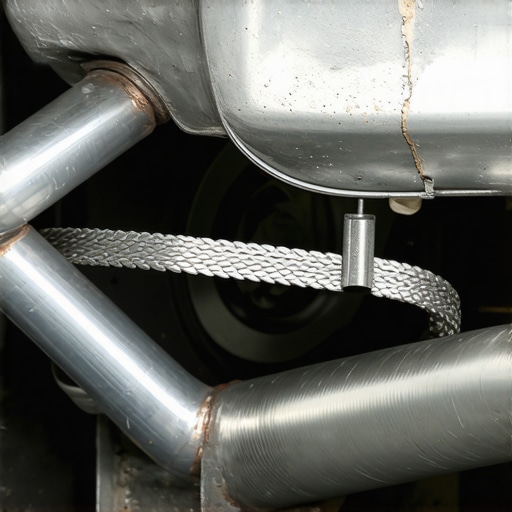
Inspect Your Rubber Hangers for Dry Rot
Sometimes the noise isn’t metal-on-metal; it is the exhaust pipe physically striking the frame because a rubber hanger has snapped. These thick rubber loops are meant to absorb vibration, but they dry out and crack over time. If you see visible cracks or if the pipe hangs noticeably low, swap them out immediately. Taking care of these small components helps maximize your cars lifespan with regular tune ups and prevents expensive exhaust leaks. If the noise is coming from inside the cabin rather than underneath, it might even be the 10 minute fix for a rattling passenger seat. Always check the simple physical connections first before assuming you need a whole new system as part of your essential car service tips for safe summer drives.
While a $5 clamp might fix your immediate heat shield headache, the real skill in automotive maintenance is knowing when a rattle is just a rattle and when it’s a symptom of a systemic failure. Most people fall into the ‘parts cannon’ trap—firing expensive components at a problem without a proper diagnosis. It’s a common mistake even for intermediate DIYers. You hear a sound, Google the symptoms, and suddenly you’re buying a new catalytic converter when all you needed was to tighten a bracket. This is where most shops make their money; by treating the symptom rather than the cause, they leave the real issue to fester while you pay for parts you didn’t need.
The ‘Parts Cannon’ Trap That Drains Your Wallet
In my experience, the biggest myth in car care is that ‘new’ always equals ‘fixed.’ I’ve seen enthusiasts swap out entire exhaust manifolds because they thought a flange was warped, only to realize the top signs your car needs expert auto repair now were actually just a loose oxygen sensor. Before you spend hundreds, you have to understand harmonic resonance. Sometimes a noise at 2,000 RPM isn’t a broken part; it’s just the frequency at which a slightly loose bolt decides to sing. This is exactly why most Libertyville shops misdiagnose a simple oil pan leak as a major repair—they look for the most expensive possibility first rather than the most logical one.
Why does my car feel sluggish even when the engine sounds fine?
This is a question I get all the time from readers who have ‘fixed’ their rattles but still feel a lack of power. It’s easy to focus on the noise and ignore the performance. If you’ve addressed the heat shield but the car still lacks pep, you might be looking at why your car feels sluggish even after a new air filter. Often, an exhaust leak—even a tiny one near the manifold—tricks the upstream oxygen sensor into thinking the engine is running lean. The computer then dumps extra fuel into the cylinders, killing your gas mileage and making the car feel heavy. This nuance is something the average ‘parts changer’ misses entirely. They see a code and replace a sensor, whereas a pro looks for the tiny pinhole leak in the pipe that caused the sensor to trip in the first place.

Even more complex is the relationship between vibrations and your gearbox. I’ve had friends swear their car needed a rebuild because of a shudder, not realizing that how transmission overhauls save you money in the long run only applies if the transmission is actually the problem. Often, a failing CV joint or a bad motor mount sends vibrations through the drivetrain that mimic a slipping clutch. According to a report by the Car Care Council, nearly 25% of cars on the road have at least one unaddressed maintenance issue that could lead to a ‘false positive’ diagnostic. This leads to the ‘oops’ factor: spending $2,000 on a transmission when a $150 motor mount was the culprit. To maximize your cars lifespan with regular tune ups, you must be surgical with your diagnostics.
Stop assuming every vibration is a transmission catastrophe
Don’t let the fear of a massive bill cloud your judgment. If your car is making a tapping sound like a typewriter, it might just be low oil or a sticky lifter, not a dead engine. Always start with the simplest, most accessible physical connections before moving to the computer. A study by the AAA Foundation for Traffic Safety highlights that over-repairing is a significant drain on consumer finances, often because drivers don’t ask for a second opinion on ‘ghost’ noises. Have you ever fallen into this trap? Let me know in the comments. Did you ever replace a major component only to find out it was something small and stupid? Let’s talk about it before you head out for those essential car service tips for safe summer drives.
Invest in a Real Scanner Not Just a Code Clearer
If you’re serious about avoiding the “parts cannon,” you need more than a $20 Bluetooth dongle from a gas station. I personally swear by the Autel MaxiCOM or even a mid-range BlueDriver because they allow you to see fuel trims and O2 sensor voltages in real-time. This is exactly how to read live data to find a misfire before it destroys your ignition coils. When I’m troubleshooting, I’m looking at the Short Term Fuel Trim (STFT). If it’s spiking, I know I have a vacuum leak or a fuel delivery issue, regardless of what the “Check Engine” light says. This level of detail is what separates a backyard tinkerer from someone performing a professional-grade tune up. In fact, according to SAE International’s J1979 standard, which governs how diagnostic data is communicated, modern vehicles provide hundreds of data points that most drivers ignore until it’s too late.

How do I maintain my car’s health over the long haul?
Maintenance isn’t a one-time event; it’s a rhythm. For me, that means obsessive fluid management. We often talk about oil, but your transmission is the most neglected “lung” of your vehicle. You need to understand why your transmission shifts better when its hot and why cold-start shudders are a warning sign. Don’t wait for a failure to consider how transmission overhauls save you money in the long run by catching wear before the gears are ground to dust. I also keep a simple logbook—yes, a physical one—to track every essential car service tip I’ve applied. It helps me spot patterns, like a recurring battery drain that might actually be the hidden drain that kills your battery overnight. Consistency is what keeps a 200,000-mile car feeling like it just rolled off the lot.
Predictive Maintenance is the New Normal
Looking ahead, the “wrench and hammer” era is fading into the “data and sensor” era. I predict that within five years, even budget-friendly cars will have built-in predictive algorithms that tell you a wheel bearing is going to fail 500 miles before you can even hear it. We are moving away from reactive expert auto repair and toward a world where your car “calls home” to order its own parts. Until then, you are the algorithm. You have to be the one to notice the small things, like why your car key gets stuck in the ignition lock or how to perform the trick to cleaning battery corrosion with baking soda and water to prevent terminal rot. Stop waiting for the warning light to dictate your weekend plans. Grab a decent scanner this Saturday and look at your fuel trims. You might just find that $10 vacuum leak before it turns into a $1,000 “catastrophic” repair.
Why My Biggest Repair Blunders Were Actually a Gift
Looking back, every dollar I wasted on a part I didn’t need was actually a tuition payment to the School of Real-World Mechanics. If I hadn’t spent hundreds on a radiator when I only had a loose hose, I never would have learned to slow down and trace the source of the leak. I have realized that the 5 red flags to watch for when choosing an albuquerque mechanic often apply to ourselves when we rush a diagnosis; we get impatient and start guessing. Another lightbulb moment was accepting that some cars reach a point where repair is no longer the smartest move. Knowing the honest way to get a fair price for a car with a blown engine is just as important as knowing how to change the oil. It is all about being realistic with your time and your bank account balance.
The Gear That Saved My Sanity and My Wallet
If you are going to step into the world of DIY, you need a few non-negotiables in your garage. First, a high-quality set of ramps because crawling under a car should never feel like a death-defying act. Second, an OBD2 scanner that supports live data streams. Learning how to read live data to find a misfire is a genuine superpower that prevents you from buying ignition coils you do not actually need. I also highly recommend the 15 tool to find a short circuit in your dash; it turns a nightmare electrical hunt into a five-minute job. These tools pay for themselves the very first time you avoid even a single hour of professional shop labor charges.
Your Car Deserves a Confident Driver
The relationship you have with your vehicle changes forever once you stop fearing the noises it makes. When you realize that you have the power to maximize your cars lifespan with regular tune ups, you stop being a passenger in your own maintenance journey. Every small fix, from a five-dollar heat shield clamp to following essential car service tips for safe summer drives, builds the muscle memory of a true car owner. Do not be afraid to get your hands dirty this weekend. You are not just fixing a machine; you are mastering it. What is the one car noise that has been haunting your commute lately? Tell me the sound and where you think it is coming from in the comments below, and let’s troubleshoot it together!