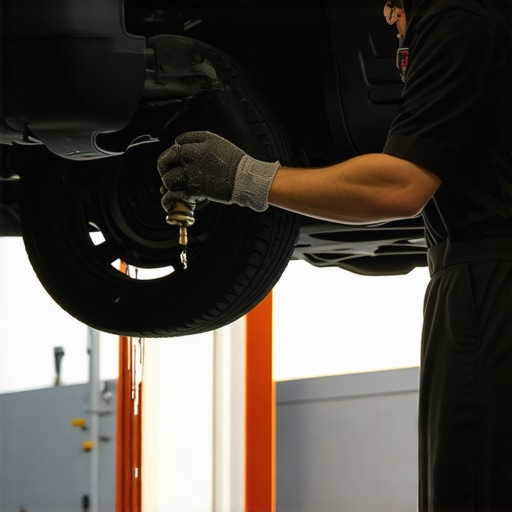
Why Most Libertyville Shops Misdiagnose a Simple Oil Pan Leak as a Major Repair
It starts with a single, dark droplet on your driveway. You might ignore it for a week or two, but eventually, that droplet turns into a puddle. For many residents seeking auto repair libertyville il, that puddle represents more than just a mess – it represents “driveway dread.” You take your vehicle into a local shop or a large dealership, and within thirty minutes, the service advisor comes back with a grim face and a quote for $2,000 to replace a “rear main seal.”
My name is Yony Turcios, and I am the Owner and President of Auto Lab in Libertyville. I’ve been in this industry since 2005, and I’ve seen this exact scenario play out hundreds of times. Auto Lab was founded by Kevin Riddick with a mission of transparency, and I carry that torch today to ensure our neighbors aren’t overcharged for repairs they don’t actually need. The truth is, a significant portion of those “catastrophic” rear main seal leaks are actually simple oil leak repair jobs involving the oil pan or a valve cover. In this deep dive, I want to pull back the curtain on why these misdiagnoses happen and how you can protect your wallet.
The Geography of an Oil Leak: Why Mechanics Get It Wrong
To understand why a misdiagnosis is so common, you have to understand the physics of an engine bay. An internal combustion engine is a complex assembly of metal, gaskets, and high-pressure fluids. When oil escapes its designated path, it doesn’t just sit there. Because of the way engines are angled and the way air flows through the engine bay while you are driving at 60 MPH down I-94, oil almost always travels down and toward the back of the car.
This is what we call the “gravity trail.” An oil leak might start at the very top of the engine – perhaps at the valve cover or the oil filter housing – but by the time it reaches the bottom of the vehicle, it has coated the entire rear of the engine block. Specifically, it often pools around the transmission bell housing. The transmission bell housing is exactly where the rear main seal lives. To an untrained or rushed eye at a carmax repair shop, seeing oil at the junction of the engine and transmission is an automatic “rear main seal” diagnosis.
However, technical research and years of hands-on experience tell a different story. For example, on many modern Chevy and GM trucks, the rear main seal is frequently blamed for leaks that are actually coming from the oil cooler lines or the oil pan gasket. One of the most effective ways to verify this is the “Inspection Cover” method. Most vehicles have a small metal or plastic plate between the engine and the transmission. By removing this plate, a technician can see the flywheel or flexplate. If the back of the flywheel is bone dry, it is physically impossible for the rear main seal to be the source of the leak. Unfortunately, many shops skip this five-minute step and jump straight to the high-ticket quote.
The $1,500 Mistake: Oil Pan vs. Rear Main Seal
The difference between an oil pan repair and a rear main seal replacement isn’t just a few dollars – it’s often a difference of $1,000 to $1,500 in labor. An oil pan is an external component. While some modern vehicles require subframe movement to access it, it is generally an “external” fix. Conversely, a rear main seal is located deep inside the engine assembly where the crankshaft meets the transmission. To replace it, the entire transmission must be disconnected and removed from the vehicle.
I often see customers come in for a second opinion after being told they need a massive overhaul. Often, we find that the culprit is simply a $15 gasket that has become brittle over time. When a shop misdiagnoses this, they might actually replace the rear main seal, but because they have to remove the oil pan to get to it, they end up “fixing” the real leak (the pan) by accident while charging you for the much more expensive transmission labor. At AutoLab Libertyville, we find that level of “accidental fixing” to be unethical.
It is also worth noting that a stripped oil drain plug can sometimes mimic a larger pan leak. If the plug isn’t seating correctly, oil can spray backward while driving, coating the bottom of the pan and making it look like the gasket has failed entirely. We always check the simplest solutions first.
The “Big Box” Service Problem in Libertyville
Why do these misdiagnoses happen so frequently at places like libertyville vw or through carmax servicing? It usually comes down to the business model. High-volume service departments are often driven by “book time” and efficiency metrics. In a carmax service department, technicians are often pushed to process as many vehicles as possible to maintain the carmax car service throughput.
When a technician is under the clock, they are less likely to perform a thorough degreasing and UV dye test. They see oil near the transmission, they check the “standard” high-failure part for that mileage, and they write the quote. Furthermore, if you are using a MaxCare warranty, the shop has to justify the repair to an adjuster. Sometimes, it’s easier for a shop to get a major repair approved than a minor one, even if the minor one is what’s actually needed. However, be careful – your CarMax service department might deny your claim if they suspect the diagnosis was lazy or if the leak is considered “seepage” rather than a “failure.”
At Auto Lab, we aren’t beholden to corporate quotas. Whether you come in for a simple carmax oil change (we service all MaxCare and third-party warranties) or a complex engine teardown, our diagnostic process remains the same. We treat your car like it’s our neighbor’s – because in Libertyville, it usually is.
Specific Red Flags for BMW and Jeep Owners
If you are looking for the best jeep service near me or specialized bmw oil leak repair, you need to be especially wary of the rear main seal misdiagnosis. These brands have very specific engineering quirks that lead to “ghost leaks.”
The BMW “Trickle Down” Effect
BMW engines, particularly the N52, N54, and N55 inline-sixes, are notorious for oil filter housing leaks. The BMW oil leak spot that most shops miss is actually high up on the front of the engine. The oil leaks from the housing, runs down the front of the block, gets caught by the serpentine belt, and is flung all over the underside of the engine. By the time it settles, it looks exactly like a rear main seal or an oil pan failure. Replacing the oil filter housing gasket is a fraction of the cost of a rear main seal, yet we see BMW owners quoted for the latter every single week in Libertyville.
Jeep Pentastar Issues
For Jeep owners, the 3.6L Pentastar engine has a common failure point: the oil filter adapter housing located in the “V” of the engine. When this plastic housing cracks or the O-rings fail, oil pools in the valley of the engine block. Once that valley fills up, the oil spills over the back of the engine and drips down the transmission bell housing. Again, this creates a visual “perfect match” for a rear main seal leak. If your shop doesn’t use a flashlight to look deep into the engine’s valley, they are going to cost you thousands in unnecessary labor.
Beyond Oil: Other Common Fluid Misdiagnoses
Oil isn’t the only fluid that gets misdiagnosed in libertyville car repair. We often see confusion regarding transmission leak repair fluid. Transmission fluid is typically red or pinkish (though it turns brown as it ages), while engine oil is amber or black. A leaking front pump seal on a transmission can look identical to a rear main seal leak because they occur in the exact same physical location. Using the wrong fluid to “top off” a leak can lead to catastrophic failure, making transmission overhauls necessary when a simple seal replacement would have sufficed.
We also see issues with the evaporative emission system repair (EVAP). A customer might come in because an evap system leak detected code (like P0442 or P0455) triggered their check engine light. Some shops will immediately recommend replacing the entire charcoal canister or the fuel tank. In reality, an EVAP leak can be as simple as a loose gas cap or a cracked vacuum line. Much like the oil pan vs. rear main seal debate, the key is the diagnostic process. We use smoke machines to pinpoint the exact exit point of the vapors rather than guessing based on a computer code. This prevents you from paying for parts you don’t need, ensuring your regular tune-ups actually keep your car running efficiently without breaking the bank.
The Auto Lab Difference: Our Diagnostic Process
So, how do we avoid these expensive mistakes at Auto Lab? We follow a strict three-step protocol for every oil leak repair:
- The Clean Slate: We don’t diagnose a dirty engine. We use professional-grade degreasers to clean the entire underside of the engine and transmission.
- UV Dye Trace: We add a specialized fluorescent dye to the oil system. The customer then drives the car for 50-100 miles.
- Blacklight Inspection: When the car returns, we use a UV blacklight. The dye glows brightly at the *exact* point of origin. This removes all guesswork. If the glow is coming from the top of the pan, it’s a pan leak. If it’s coming from *inside* the bell housing, only then do we recommend a rear main seal.
We understand that unexpected repairs can be stressful. That is why we offer Synchrony Car Care financing options to help our customers manage the costs of necessary repairs. Our goal isn’t to hit a “sales target”; it’s to ensure your vehicle is safe and reliable for the long haul. Whether you need an oil change carmax won’t provide with a personal touch, or a complex evaporative emission system repair, we provide digital inspections with photos so you can see exactly what we see.
Conclusion: Don’t Settle for the First Quote
If you’ve been told your car needs a $2,000 rear main seal repair, don’t panic. There is a very high statistical probability that you are looking at a much simpler oil pan repair or a top-end gasket leak. Libertyville drivers deserve honesty and technical precision, not just “book time” estimates from a carmax service department.
At Auto Lab, I invite you to come in for a second opinion. Let us put your vehicle on the lift, show you the “gravity trail,” and perform a proper dye test. We’ve been saving Libertyville residents from unnecessary repairs since 2005, and we’re ready to do the same for you. Don’t let a simple leak turn into a financial headache – visit us at Auto Lab and experience the difference that true expertise makes.