The 2-Minute Click Test: Is Your Starter or Battery Actually Dead?
It is a scenario every driver in the Shreveport/Bossier City area dreads. You are running late for work, you hop into your vehicle, turn the key or press the start button, and… nothing. Or perhaps worse, you hear a series of strange noises that leave you wondering if your car is about to undergo a costly breakdown. When your vehicle refuses to turn over, the two most common culprits are a dead battery or a failing starter motor. But how do you tell the difference without a tow truck and a professional diagnostic tool?
My name is Michael Dale, and I’ve spent years helping local drivers navigate the frustrations of vehicle maintenance. Whether you are looking for a reliable used vehicle or trying to keep your current car on the road, understanding the basics of auto diagnostics can save you hundreds of dollars and hours of frustration. According to AAA, battery-related issues remain the #1 cause of roadside assistance calls in the United States. However, many people replace their batteries only to find the “new” battery doesn’t fix the problem because the starter was the actual issue. That is why I developed the “2-Minute Click Test.” This simple diagnostic method allows you to use your ears and eyes to identify the source of the failure before you call for auto repair shreveport.
Understanding the Starting Trinity: Battery, Starter, and Alternator
To diagnose a “no-start” condition, you first need to understand how your car actually wakes up. Think of it as a “Starting Trinity” consisting of the battery, the starter, and the alternator. These three components must work in perfect harmony to get you moving. If any one of them fails, you aren’t going anywhere.
The battery is your vehicle’s storage tank for electricity. It provides the initial surge of power – the “spark” – needed to wake up the electronics and energize the starter motor. The starter motor is the “muscle” of the operation. It takes that electrical energy and converts it into mechanical energy, physically spinning the engine’s crankshaft until the internal combustion process takes over. Finally, once the engine is running, the alternator takes over. It acts as a generator, supplying electricity to the car’s systems and recharging the battery so it’s ready for the next start.
Problems arise when this cycle is broken. For example, if your alternator is failing, it won’t recharge the battery while you drive, leading to a “dead” battery the next morning. You might even need to Stop your alternator from killing your battery every night if a faulty diode is causing a parasitic drain. Understanding this relationship is the first step in realizing that a car that won’t start isn’t always suffering from a “dead” battery; sometimes, the battery is just the victim of a larger system failure.
The 2-Minute Click Test: A Step-by-Step Guide
The core of this diagnostic method is simply listening. When you turn the ignition, your car is “talking” to you. The sounds it makes (or doesn’t make) provide a roadmap to the problem. Here is how to perform the 2-minute click test to see if you need shreveport auto repair.
Scenario A: The Rapid-Fire Click
If you turn the key and hear a rapid-fire click-click-click-click sound, you are likely dealing with a low battery. This sound occurs because there is enough voltage (usually around 10 to 11 volts) to engage the starter solenoid, but as soon as the solenoid tries to pull the heavy electrical load required to turn the starter motor, the voltage drops. This causes the solenoid to disengage, then re-engage as the voltage bounces back, creating that signature machine-gun clicking sound.
In this case, your battery likely has a surface charge but lacks the “Cold Cranking Amps” (CCA) to do the heavy lifting. This is a common sign that you need to visit starter repair shops near me for a battery replacement or a charging system test.
Scenario B: The Single Loud Thunk or Click
If you hear one loud CLACK or a single solid “thunk” and then nothing, the diagnosis shifts toward the starter motor. This sound indicates that the battery is sending plenty of power to the starter solenoid, and the solenoid is successfully pushing the starter gear forward to meet the engine’s flywheel. However, the motor itself is seized or the electrical brushes inside the starter have failed. The battery is doing its job, but the “muscle” is paralyzed. Before assuming the worst, check The Secret Reason Your Car Won’t Start When the Engine is Hot, as heat soak can often cause starters to seize temporarily.
Scenario C: Total Silence
If you turn the key and hear absolutely nothing – no clicks, no whirring, no lights on the dash – you are likely looking at a “hard” electrical failure. This could be a completely discharged battery (0 volts), a blown main fuse, or a failed ignition switch. It could also be a safety feature; modern cars won’t start if they don’t think the car is in “Park” or “Neutral.” Try shifting to Neutral and starting again. If it still fails, you may need a certified auto repair service to track down a broken connection.
Visual Cues: What Your Dashboard and Headlights Are Telling You
While your ears are the primary tool for the click test, your eyes can provide the confirmation you need. One of the oldest tricks in the book is the “Headlight Test.” Turn your headlights on and attempt to start the car. Watch the beam of the lights against a wall or garage door.
- Lights Dim Significantly: If the lights nearly go out when you try to start the engine, the battery is the culprit. It is struggling to provide enough current for both the lights and the starter.
- Lights Stay Bright: If the headlights remain bright and steady while you hear that “single click” from the starter, your battery is healthy. The problem is almost certainly the starter motor or the wiring leading to it.
Additionally, look at your dashboard. If the lights flicker wildly during the rapid-fire clicking, it confirms a voltage drop. If you see a battery icon illuminated while driving, that is a warning from the alternator. Sometimes, the issue isn’t the battery’s internal chemistry, but a connection problem. Be sure to check The Corrosion Spot on Your Battery That Mimics a Dead Alternator. A small amount of white, crusty oxidation on the terminals can prevent the battery’s power from reaching the rest of the car, even if the battery itself is brand new.
Technical Validation: Using a Multimeter
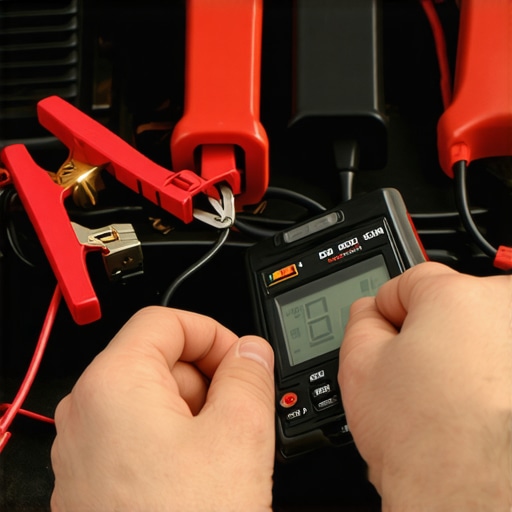
If the 2-minute click test leaves you with questions, it is time for a bit of technical validation. A basic multimeter is a tool every car owner should have. It allows you to move beyond “guessing” and into “measuring.”
Set your multimeter to DC Voltage (20V range). With the engine off, touch the probes to the battery terminals. A fully charged, healthy battery should read 12.6 volts. If you see 12.2 volts, your battery is only at a 50% charge. If it reads 12.0 volts or lower, the battery is effectively dead and likely won’t have the strength to turn the engine over.
The real test, however, is the “cranking voltage.” Have a friend attempt to start the car while you watch the meter. If the voltage drops below 10 volts during the cranking attempt, the battery is failing and needs to be replaced at one of the starter repair shops near me. If the voltage stays high (above 11V) but the car won’t start, the battery is fine, and the electrical bottleneck is elsewhere – most likely the starter motor or a loose ground wire.
Why Local Expertise Matters in Shreveport/Bossier City
Living in the Shreveport/Bossier City area presents unique challenges for vehicle electronics. While many people associate battery failure with the bitter cold of Northern winters, the truth is that heat is a much more aggressive battery killer. In Louisiana, summer temperatures regularly exceed 95°F, and under-hood temperatures can soar well above 140°F. This extreme heat causes the liquid electrolyte inside lead-acid batteries to evaporate, leading to internal structural damage and shortened lifespans.
This is why having a local mechanic Shreveport is so vital. We understand the local climate and the specific wear-and-tear it puts on vehicles. When you visit integrity imports, you aren’t just getting a part swapped out; you are getting a certified auto repair service that understands the nuances of local driving conditions. Whether you need a simple oil change in bossier city or a complex electrical diagnostic, local experts can ensure your vehicle is prepared for the Louisiana humidity and heat.
Furthermore, local shops like auto repair in bossier city can perform a “load test” which is much more accurate than a simple voltage check. They can simulate the draw of a starter motor to see exactly how your battery performs under pressure, ensuring you don’t get stranded at the Boardwalk or out in South Shreveport.
Common “Fake-Outs” That Aren’t the Starter or Battery
Sometimes, the 2-minute click test might lead you to believe a major component has failed when the fix is actually much simpler. Before you commit to a new starter, consider these “fake-outs”:
- The Neutral Safety Switch: As mentioned earlier, if your car is not fully in “Park,” it won’t start. Try jiggling the shifter or shifting into Neutral.
- Loose Ground Straps: Your car’s electrical system relies on a complete circuit. If the “ground” connection between the engine and the frame is loose or corroded, the starter won’t get enough power. Interestingly, this can also cause The $10 ground strap that fixes weird radio interference. If your radio is acting up and your car is starting slowly, check your grounds!
- Blown Fuses: Check the “Starter” or “IGN” fuse in your engine bay fuse box. A $2 fuse can sometimes mimic a $300 starter failure.
- Security Systems: Sometimes a failing key fob battery or an anti-theft system glitch will prevent the car from starting. If you see a “key” icon flashing on the dash, it’s a security issue, not a mechanical one.
If you find yourself constantly dealing with these small but annoying issues, it may be among the Top Signs Your Car Needs Expert Auto Repair Now. Don’t let a small electrical gremlin turn into a major breakdown on I-20. Also, if you hear other strange noises, like a Stop That Annoying Tick-Tick-Tick Sound in Your Engine or struggle with The $15 Valve That Solves Your Hard-to-Start Engine Problems, it is time to seek professional help.
Conclusion & Next Steps
The “2-Minute Click Test” is a powerful tool for any driver. By distinguishing between the rapid clicking of a weak battery and the single thunk of a dead starter, you can take control of your vehicle’s maintenance. However, a DIY diagnosis is just the first step. For a definitive answer and a permanent fix, you should always consult a professional auto repair service center.
If you are in the Shreveport or Bossier City area and your car is giving you trouble, don’t stay stranded. Reach out to the experts at integrityautorepair.net for a comprehensive diagnostic. Whether it is a battery replacement, starter repair, or just an oil change in bossier city, getting the job done right the first time is the best way to keep your vehicle safe and reliable. For more expert tips, remember to check out integrityautorepair.net or integrityautorepair.net for all your automotive needs.