I still remember the first time I heard ‘the drone.’ I was cruising down the I-77, windows up, AC on, when a low-frequency hum started vibrating through my seat. It felt like I was being followed by a propeller plane. My first instinct? I blamed my cheap tires. I even went out and bought a brand new set of Michelins the next day. The noise stayed. I felt like an idiot. I had just thrown hundreds of dollars at a problem that wasn’t actually there, all because I didn’t know how to spot a bad wheel bearing by ear. It was an expensive lesson in ego, but it taught me that your car is always trying to talk to you; you just have to learn the language.
That Persistent Hum Might Be More Than Just Road Noise
When you hear a rhythmic growl that gets louder as you speed up, your brain usually jumps to the easiest conclusion: the tires are old. While it is true that certain tread patterns can get noisy as they wear down, a failing wheel bearing is a different beast entirely. It is a mechanical failure that can become dangerous. If you have noticed that your steering wheel shakes at exactly 60 mph, you are already dealing with a car that is crying out for attention. My goal today is to give you the exact ‘ear-test’ methods I use to tell these two apart so you do not waste money at the tire shop like I did. We are going to look at how the sound changes when you turn, how the vibration feels in your feet, and why ignoring this could lead to a much more expensive expert auto repair later on.
Is This Going to Be a Total Wallet-Drainer?
The biggest fear I hear from my neighbors is that any noise involving the wheels means a four-figure repair bill. I get it. Auto shops can be intimidating. But here is the reality: catching a bearing early is a standard job, while letting it seize can destroy your axle and spindle. According to the National Highway Traffic Safety Administration (NHTSA), mechanical failures in tires and wheels are leading contributors to loss-of-control accidents, making this diagnosis a matter of safety, not just comfort. Have you ever turned up the radio just to drown out a weird vibration coming from the floorboards? If so, you are playing a dangerous game with your commute. By performing a few simple maneuvers in a vacant parking lot, you can isolate the sound and decide if you need a simple regular tune up or something more specific. Let us dive into the ‘swerve test’ that reveals the truth in seconds.
Shift the Weight to Find the Failing Side
The most effective way to separate a bearing issue from tire noise is the swerve test. Think of your car’s weight as a spotlight. When you steer, you are throwing that weight onto one side of the vehicle and lifting it off the other. To do this, find a flat, empty stretch of road where you can safely cruise at about 35 mph. Gently weave the car left and right, like a skier navigating a slope. If the rhythmic growl disappears when you veer left but screams louder when you steer right, you have likely isolated a failing left-side bearing. Why? Because you unloaded the left side, giving the damaged metal a temporary break from the pressure. In contrast, tire noise stays constant regardless of which way you turn because the tread contact remains relatively stable. If you find that your car pulls to the left when you accelerate alongside this noise, you are looking at a hub assembly that is likely creating massive drag.
Put the Car on Jack Stands to Confirm
If the swerve test is the hint, the ‘spin and feel’ is the proof. You need to get the wheels off the ground. Once the car is securely on jack stands, put your hand on the coil spring while someone spins the wheel as fast as they can. A healthy bearing is like a high-end fidget spinner—it should be silent and smooth. If you feel a vibration or a ‘gritty’ sensation through the spring, the bearing is shot. I once spent an afternoon helping a neighbor who was convinced he needed a total transmission overhaul because of a heavy whining sound. We lifted the car, spun the front right wheel, and the vibration was so violent it felt like holding a vibrating phone. It was a $100 part, not a $3,000 transmission. This simple check saves thousands in misdiagnosed labor.

The 12 and 6 Shake That Reveals the Truth
While the car is still in the air, grab the tire at the 12 o’clock and 6 o’clock positions. Try to rock it back and forth. There should be absolutely zero ‘play.’ If you feel a click or a wobble, the internal races of the bearing have worn down to the point of structural failure. This is different from steering issues where your car vibrates specifically at 45 mph due to unbalanced rubber. This is mechanical slop. Be careful, though; if you have a stuck wheel, you might need to learn the secret to removing a stuck wheel from a rusty hub before you can even get a good look at the assembly. I’ve seen people mistake a loose tie rod for a bad bearing, but the ’12 and 6′ method isolates the hub specifically. If the wheel moves when you grab it at 3 and 9, it’s likely your steering linkage, but top-to-bottom movement is almost always the bearing’s final goodbye.
Don’t Ignore the High Pitched Warning
Sometimes, a bearing doesn’t growl; it whistles. I remember a Mazda 3 that came into the shop where the driver swore they had a vacuum leak. They had read about what that high-pitched whistle under your hood really means and were looking for a cracked hose. We went for a ride-along, and the moment I heard the pitch change as we hit a curve, I knew. It wasn’t air escaping; it was a dry bearing cage singing a death song. We swapped the hub, and the ‘engine whistle’ vanished instantly. These sounds are deceptive, but by applying these physical tests, you remove the guesswork and keep your wallet intact.
Even with the physical tests I just shared, there is a massive trap that I see veteran DIYers fall into all the time: the obsession with the ‘tune-up’ as a cure-all. We have been conditioned to think that if a car feels ‘off’ or makes a weird vibration, it just needs new plugs and filters. In reality, modern cars rarely need a traditional ‘tune-up.’ If you are hunting for a noise and think you can maximize your cars lifespan with regular tune ups, you are half-right, but you might be ignoring the mechanical integrity of your drivetrain. Most people assume that a rhythmic vibration is an engine miss, when it is actually a hub assembly on its last legs. I have seen folks replace their entire ignition system only to find out that the ‘stutter’ they felt was actually the ball bearings in their wheel hub binding up at high speeds.
Don’t Flush Your Cash Down the Drain
Here is a contrarian take that might upset some service writers: a transmission flush can sometimes be the worst thing you do for a car that is already acting up. If you hear a whining sound and jump straight to the shop for a fluid swap, you might be accelerating the end. I always tell people to understand the difference between a transmission flush and a simple fluid change before they spend a dime. If that ‘transmission whine’ is actually a wheel bearing, you’re performing surgery on the wrong organ. One of the biggest ‘oops’ factors I encounter is the owner who flushes a high-mileage transmission because of a noise, only to have the new, high-detergent fluid wash away the friction material that was actually keeping the gears grabbing. According to the National Institute for Automotive Service Excellence (ASE), accurate diagnosis is the most critical step in preventing ‘comebacks’—those annoying return trips to the shop because the first repair didn’t fix the actual problem.
#IMAGE_PLACE_HOLDER_C#
Can a Faulty Ground Wire Actually Mimic a Mechanical Grind?
This sounds like a stretch, but hear me out. Modern vehicles use wheel speed sensors that sit directly on top of the bearing. If you have an electrical issue, specifically if you need to diagnose a bad ground wire in minutes, it can cause the ABS system to ‘chatter’ or pulsate the brakes very lightly. To the driver, this feels like a gritty, grinding bearing or a warped rotor. I once worked on a truck where the owner was ready for expert auto repair on his front end. It turned out a loose ground wire was making the ABS pump fire intermittently, creating a mechanical vibration that felt exactly like a dry bearing. Before you tear your suspension apart, check your electrical basics and look for essential car service tips that include cleaning your battery terminals. It sounds too simple to be true, but the intersection of electronics and mechanics is where most mistakes are made. Have you ever fallen into this trap and replaced a perfectly good mechanical part only to find out it was a $5 fuse or a loose wire? Let me know in the comments below.
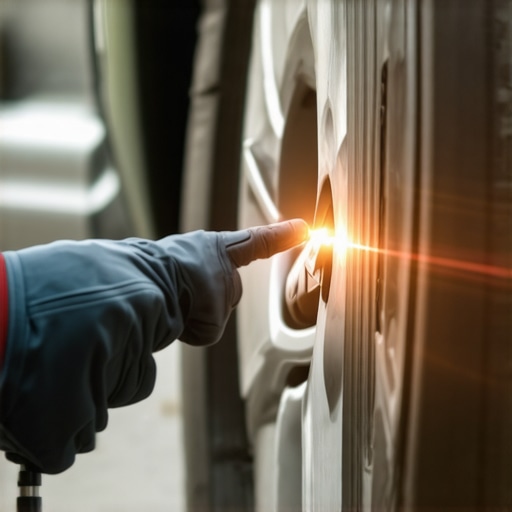
If you are serious about avoiding a massive bill for an unnecessary transmission or hub repair, you need to stop relying solely on your ears. I have reached a point where I do not even jack up a car without grabbing my infrared thermometer first. It is the ultimate lie detector. After a twenty-minute drive, I point that laser directly at the center of the wheel hubs. If the driver’s side is reading 110 degrees and the passenger’s side is screaming at 160, I do not need a swerve test to tell me which bearing is failing. This is far more effective than a generic regular tune up because it targets heat—the silent killer of mechanical parts. For the electrical side, I always keep a specific multimeter on hand because it is the $15 tool to find a short circuit in your dash without tearing the whole interior out. You have to be surgical. Most shops will just start throwing parts at the problem, but when you learn how to read live data to find a misfire or a wheel speed sensor drop-out, you become the most informed person in the garage.
How do I maintain my wheel assemblies over time?
The secret is not just about changing the grease; it is about protecting the sensors and the seals. I make it a habit during every essential car service tips session to inspect the rubber boots on my CV axles. Once that boot rips, road salt gets in, and your bearing’s days are numbered. I also treat my electrical connections like gold. If you know how to clean battery terminals so they never corrode again, you are actually protecting your transmission’s computer from receiving ‘dirty’ voltage signals that cause erratic shifting. According to the SKF Technical Support Guide for Hub Units, even a microscopic amount of debris between the hub and the knuckle can lead to ‘runout,’ which eventually kills the bearing and warps your rotors. Precision is everything. If you catch these issues early, you can avoid the high costs of how transmission overhauls save you money in the long run by simply maintaining the peripheral components first.
Predictive Tech is Changing the Way We Listen to Our Cars
In the next few years, I predict we will see affordable, clip-on acoustic sensors that sync with your smartphone. We won’t have to guess if we are hearing a bearing or a tire; an app will analyze the frequency and tell us the exact remaining life of the component. Until then, you need to be the sensor. If you feel that rhythmic pull or hear that low drone, do not wait for expert auto repair to be your first call. Check your hubs, verify your grounds, and decide if the repair is something you can handle. I challenge you to go out today and try the ‘infrared test’ after your next commute—you might be surprised by what your car is trying to tell you about its hidden friction points.
The Hardest Lesson I Learned About Drivetrain Diagnostics
I used to be the guy who replaced the whole suspension because of a tiny rattle. It was a cycle of frustration and empty pockets. Here is what I know now: sound is a liar. You might think you have a mechanical grind when you actually just have a piece of loose plastic. I have learned that if your car feels like its dragging an anchor, it is rarely the big-ticket items like the engine; it is usually friction in the hubs or brakes. Secondly, expensive tools are great, but your hands and a cheap thermometer are often more accurate than a $5,000 scanner. Finally, always rule out the weird stuff first. I have seen a rattling heat shield sound exactly like a failing bearing—you can usually fix a rattling exhaust for under $10 if you just take five minutes to look underneath.
My Go-To Kit for Tracking Down Car Noises
You do not need a professional shop to be a diagnostic pro. I personally rely on a simple infrared laser thermometer to find heat spikes in wheel hubs. It is the most honest tool in my bag. I also swear by a decent digital multimeter; it is the $15 tool to find a short circuit in your dash that might be making your sensors act crazy. For maintenance, I keep a dedicated logbook. Tracking when you actually did a regular tune up prevents you from guessing if that vibration is a spark plug or a physical part of the wheel assembly. Lastly, keep a bottle of soapy water; it is a simple way to find air leaks and even belt squeaks without guessing.
#IMAGE_PLACEHOLDER_E#
Own Your Garage Confidence
Learning the difference between a tire hum and a bearing growl is not just about saving a few hundred bucks—it is about the peace of mind that comes with knowing your vehicle is safe. When you take the time to perform these tests yourself, you stop being a victim of the parts cannon and start becoming the master of your machine. If you ever feel stuck or the noise just does not make sense, do not hesitate to contact us for a second opinion. Keeping your car on the road is a journey, and you have the tools to handle it. Have you ever been told you needed a major auto repair only to find out it was something tiny? Let me know below.