I remember sitting in my driveway three years ago, coffee in hand, listening to my trusty old sedan idle. Instead of its usual low purr, I heard it: tap, tap, tap, tap. It sounded exactly like an old-school Remington typewriter at full speed. I did what most people do—I turned up the radio and hoped it would go away once the engine warmed up. That was my first mistake. By the time I actually looked under the hood, I had turned a simple fix into a much more expensive weekend of grease and frustration. If you’re hearing that metallic clicking right now, don’t panic, but don’t ignore it either. Today, I’m going to walk you through exactly what that sound means and how we can quiet it down before it turns into a total auto repair nightmare.
That Rhythmic Tapping Is Your Engine Screaming for Help
When your car starts imitating a 1940s newsroom, it’s usually your valvetrain trying to tell you something. Specifically, it often points to your hydraulic lifters. These little components rely on oil pressure to keep everything moving smoothly, and when they lose that pressure, they start clattering against the camshaft. I used to think why your engine taps like a typewriter was just a quirk of high-mileage cars, but it’s actually a symptom of neglected maintenance. According to the Society of Automotive Engineers (SAE), nearly 75% of engine wear occurs during the first few minutes of operation when oil hasn’t fully circulated, which is often when that tapping is loudest. If you’ve been skipping out on your regular tune-ups, your oil might be too thin or too dirty to do its job. I’ve seen engines go another 100,000 miles just by addressing this sound early, but I’ve also seen them end up in the scrap heap because the owner waited too long. Have you ever noticed the sound getting louder when you’re low on oil or if it’s been a while since your last change?
Will ignoring this sound lead to a blown engine?
The short answer is: eventually, yes. It starts as a nuisance, but that tapping is actually metal hitting metal with no cushion. It’s a sign that your essential car service routine needs a serious look. Early in my DIY days, I thought I could just dump in a thick oil additive and call it a day. While some additives help, they often just mask a deeper issue like a clogged oil passage or a failing oil pump. If the tapping turns into a heavy knock, you’re looking at a much bigger bill. We want to catch it while it’s still just a “typewriter” and not a “sledgehammer.” Let’s dive into the common culprits and how you can diagnose this right in your own driveway.
Pinpoint the Sound with a Poor Mans Stethoscope
Before you start ordering parts, you need to be 100% sure where that tapping is coming from. Engines are echo chambers; a sound that seems like it is coming from the top might actually be a lower-end issue. Grab a long, heavy-duty screwdriver—the kind with a solid plastic handle. With the engine idling, touch the metal tip to various points on the valve cover and press your ear against the handle. This acts like a doctor’s stethoscope, amplifying the internal vibrations. I once used this trick to help a neighbor who was ready to give up on his old SUV. He was convinced the engine was shot, but within two minutes, I realized the noise was actually just a loose heat shield. If you find the same, you can often use a how to fix a rattling heat shield for free method rather than tearing into the block. However, if the loudest ‘clack’ is coming directly through the valve cover, you are definitely looking at a lifter or valvetrain issue.
Check Your Oil Quality Before Buying New Parts
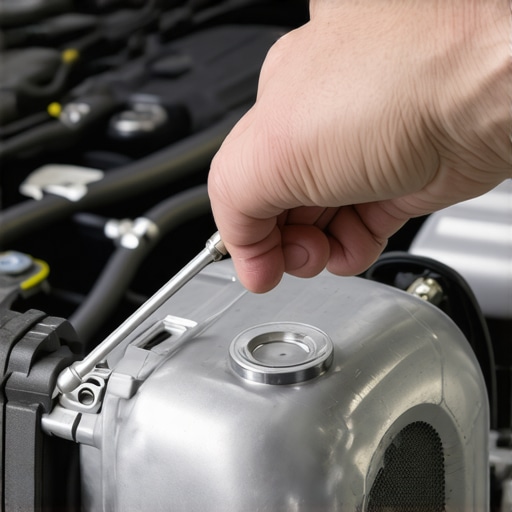
The most common reason for a tapping sound is simply that the oil isn’t reaching the hydraulic lifters. Think of your lifters like small, oil-filled shock absorbers. If the oil is too thin, too thick, or just plain dirty, they can’t ‘pump up’ to bridge the gap between the camshaft and the valves. If you have been lax with your maintenance, this is the time to commit to regular tune-ups. Check your dipstick. Is the oil jet black or does it look like chocolate milk? Black means it’s old and full of carbon; milky means you’ve got coolant mixing in, which is one of the top signs your car needs expert auto repair now. Sometimes, simply swapping out a cheap, clogged filter and adding fresh, high-quality synthetic oil is enough to flush the gunk out of the lifter and restore silence.
Try a Specialized Flush to Clear Clogged Passages
If a standard oil change doesn’t do the trick, you might have a physical blockage in one of the tiny oil galleries. These passages are barely wider than a pinhead. When carbon builds up, it acts like a clogged artery. You can try a dedicated engine flush or a high-detergent additive designed to dissolve sludge. Be careful here, though. While there is a lot of talk about the truth about high-mileage oil additives, they aren’t magic. They can help free up a ‘sticky’ lifter, but they won’t fix a metal component that has physically worn down. I remember working on a high-mileage sedan where an additive silenced the tap for about a week, but the sound returned because the lifter had a flat spot. In that case, no amount of chemical cleaning could fix a structural failure.
Ensure Your Oil Pressure Is Actually Holding Steady
Sometimes the tap isn’t the lifter’s fault—it’s the pump’s fault. If your oil pump is failing or if you have a massive leak elsewhere, the pressure won’t be high enough to fill those lifters at the top of the engine. If you notice the tapping gets worse when the engine is hot, it’s often because oil thins out as it heats up, making it harder for a weak pump to maintain pressure. Look for external leaks first; sometimes something as small as a 15 dollar gasket that stops your slow oil leak can be the difference between a healthy engine and a starved valvetrain. If you have ruled out leaks and the oil is fresh, but the why your engine taps like a typewriter sound persists, you may need to use a mechanical pressure gauge to see what the pump is actually doing at idle.
Look, I’ve heard the advice a thousand times from old-school gearheads: ‘Just throw some 20W-50 in there; it’ll quiet those lifters right down.’ While that might have worked on a 1974 heavy-duty V8, doing that to a modern overhead-cam engine is a recipe for disaster. This is where most DIYers fall into a dangerous trap. Modern engines are built with incredibly tight tolerances, often thinner than a human hair. If you use an oil that’s too thick, it can’t physically squeeze into the tiny orifices of your hydraulic lifters or the actuators for your variable valve timing. You aren’t ‘cushioning’ the metal; you’re actually starving the top end of the engine of lubrication. According to research by the American Petroleum Institute (API), using the wrong viscosity can lead to a 50% increase in startup wear because the oil takes too long to reach critical components. If you’re trying to maximize your cars lifespan with regular tune-ups, stick to the manufacturer’s weight, even if the engine has 150,000 miles on it.
Why does the tapping vanish once the engine is hot?
This is a classic symptom that separates a minor annoyance from a major failure. If the sound disappears after five minutes of driving, your lifters are likely ‘bleeding down’ overnight but are still capable of holding pressure once the oil thins out and flows. However, if the noise persists even after a long drive, you might be looking at a mechanical failure of the lifter itself or, worse, a worn camshaft lobe. I’ve seen people ignore this, thinking the car ‘fixed itself’ once it warmed up, only to realize later that the lack of lubrication was slowly eating away at the valvetrain. If you’re also noticing that your transmission shifts better when its hot, it’s a reminder that thermal expansion and fluid viscosity affect every moving part of your vehicle. Have you ever tried a ‘miracle’ fix that ended up making the noise worse? Let me know in the comments—I’ve certainly been there.
The real ‘oops’ factor I see most often in my shop is what I call ‘solvent shock.’ People dump a heavy-duty engine flush into a high-mileage car and let it idle for an hour, hoping to clear the gunk causing the tap. This can break loose huge chunks of carbon that immediately head for your oil pickup screen. Once that screen is blocked, your oil pressure drops to zero, and your engine is toast. It’s one of the top signs your car needs expert auto repair now when a simple flush turns into a seized block. Instead of aggressive chemicals, try a high-quality synthetic oil with high detergency. It cleans more slowly and safely, preventing a catastrophic blockage. If the noise is accompanied by other issues, like why your car jerks when you turn off the ignition, you may have a larger carbon buildup problem that requires a professional intake cleaning rather than just an oil additive.
Lastly, don’t confuse a lifter tick with ‘piston slap’ or a manifold leak. A lifter tick is rhythmic and fast (usually half the engine speed), whereas an exhaust leak often sounds like a ‘puff’ and may change under heavy load. If you’ve reached the point where the cost of internal engine parts exceeds the value of the ride, you might want to look into the honest way to get a fair price for a car with a blown engine before you spend a dime more on it. Sometimes, knowing when to walk away is the most ‘expert’ move you can make.
If you’ve decided that your car is worth the effort, you need to stop playing the guessing game. I spent years throwing parts at problems, hoping a new set of spark plugs or a different brand of oil would magically fix a noise. It rarely does. To really keep your car on the road without going broke, you need to invest in the right diagnostics. I personally swear by a Bluetooth-enabled OBD-II scanner. It’s not just about reading the ‘Check Engine’ light; it’s about seeing what the computer sees in real-time. Learning how to read live data to find a misfire was a game-changer for me. It allowed me to see which specific cylinder was struggling before the computer even threw a code. This kind of precision is what separates a backyard tinkerer from someone who actually knows their machine.
Ditch the Guesswork with Real-Time Data
When you can see your fuel trims and oxygen sensor voltages on your phone, you stop being a victim of ‘parts-cannon’ mechanics. For example, if you’re dealing with a mysterious hesitation, a quick look at your long-term fuel trims can tell you if the engine is running lean because of a vacuum leak or rich because of a failing injector. I also keep a few physical tools in my kit that have saved me thousands. I never go on a road trip without knowing how to find a hidden coolant leak with a pressure tester. It’s a simple tool, but it finds pinhole leaks in hoses that only open up under pressure. These are the kinds of tools that help you maximize your cars lifespan with regular tune-ups because you’re fixing problems when they cost $10, not $1,000.

How do I maintain my engine health over the long haul?
The secret isn’t just changing the oil; it’s consistency and observation. According to technical bulletins from Delphi Technologies, modern knock sensors utilize piezoelectric crystals that can detect structural vibrations at specific frequencies long before they manifest as a ‘typewriter’ sound. This means your car’s computer is constantly adjusting timing to protect the engine. To help it out, you should perform a ‘health check’ every six months. This includes checking for electrical gremlins with the 15 dollar tool to find a short circuit in your dash and ensuring your transmission fluid is still bright red and translucent. If you’ve neglected the gears, understanding how transmission overhauls save you money in the long run can help you decide if a high-mileage vehicle is worth the investment. Don’t forget the seasonal basics either; following essential car service tips for safe summer drives can prevent the heat-related stress that often causes those hydraulic lifters to fail in the first place.
The Future of Maintenance is Already in Your Pocket
I predict that within the next five years, the idea of a ‘scheduled’ oil change will be completely dead. We are moving toward 100% predictive maintenance. Cars are already starting to use AI to analyze driving habits and oil viscosity sensors to tell you exactly when the fluid is spent, rather than relying on a sticker on the windshield. This data-driven approach is the best way to avoid a auto repair nightmare. My challenge to you this week: don’t just wait for a light to pop up on your dash. Grab a basic scanner, plug it in, and look at your ‘Expected vs. Actual’ values for your timing. You might just catch a failing sensor before it leaves you stranded on the side of the highway.
The Hard Truths About Trying to Outsmart Your Engine
Over the years, I have learned that an engine noise is never just a noise—it is a conversation. One of the biggest lessons I have learned is that the most expensive oil on the shelf will not fix a mechanical failure. I used to think I could out-lubricate a worn lifter, but silence bought with thick oil is a temporary mask, not a repair. Another lightbulb moment for me was realizing that many ‘engine’ sounds are actually accessories; always check your alternator and water pump pulleys before you assume the worst. Finally, remember that consistency beats intensity. You will do more to maximize your cars lifespan with regular tune-ups than you will with any one-time ‘miracle’ flush. Patience in the driveway saves thousands at the shop.
The Diagnostic Kit That Saved My Wallet
If you are serious about keeping your high-mileage ride on the road, you need to move beyond the basic wrench set. I swear by a mechanical oil pressure gauge; it is the only way to know if your pump is actually healthy regardless of what the dash light says. For digital insights, a mid-range OBD-II scanner that provides live data is essential for learning how to read live data to find a misfire before it damages your catalytic converter. Lastly, never underestimate a simple pressure tester; I use mine constantly because how to find a hidden coolant leak with a pressure tester is a skill that prevents head gasket failures during summer heatwaves. These tools turn guesswork into certainty.
It Is Time to Silence That Tapping for Good
Taking care of your car does not have to be an overwhelming auto repair nightmare. It starts with listening. When you address that rhythmic tapping today, you are not just fixing a sound; you are preserving your mobility and your investment. Whether it is a simple oil change or a deeper dive into [how transmission overhauls save you money in the long run](https://collisionfixer.com/how-transmission-overhauls-save-you-money-in-the-long-run), every bit of maintenance counts. Don’t be afraid to get your hands dirty—your car will thank you for the next 100,000 miles. Have you ever tried a ‘miracle’ oil additive only to have the typewriter sound come right back? Let me know your experience in the comments below!