
It happened on the I-40 just outside of town. I was cruising along, the radio was up, and then the needle touched 60. Suddenly, my steering wheel felt like it was trying to escape my hands. My coffee splashed, my teeth rattled, and my first thought was ‘Well, there goes my weekend and probably my savings account.’ I spent weeks throwing money at the wrong things—new brake pads, a fresh set of spark plugs, even a fuel injector cleaner—before I realized I was solving a problem that didn’t exist. If you’ve ever gripped the wheel and prayed you weren’t about to lose a tire, you’re in the right place. Today, we’re going to pin down exactly why your car behaves like a blender at highway speeds and how you can fix it without getting taken for a ride at the shop.
Stop Ignoring the Shudder Before It Breaks Your Wallet
I’ve spent more hours under a chassis than I care to admit, and the biggest mistake I made early on was assuming that every shake meant a trip to the junkyard. I remember once I paid for a full alignment because my tires were wearing weirdly, but the shaking stayed right there at 60 mph. It turns out, tires can wear unevenly even after a shop alignment if the root cause is deeper. You need to know the top signs your car needs expert auto repair now so you don’t waste three Saturdays in the driveway like I did. Often, what feels like a catastrophic failure is just a tiny weight that fell off your rim. According to the U.S. Tire Manufacturers Association, an imbalance of just 0.25 ounces is enough to cause vibration in a modern high-performance tire. That is about the weight of two pennies! Think about that: two tiny coins can make your SUV feel like it’s falling apart. Have you ever faced this specific problem where your car feels fine at 40 but loses its mind at 60?
Do I Need to Worry About My Transmission Exploding?
It’s the first fear we all have, right? You feel a jerk or a shimmy and immediately think you’re looking at a multi-thousand-dollar overhaul. While it’s true that transmission issues can feel like neutralizing or slipping, a rhythmic shake at a specific speed is almost always related to the rotating mass—tires, wheels, or axles. I’ve seen folks panic and look for how transmission overhauls save you money when all they really needed was a $20 wheel balance. However, if the shake comes with a clunk, you might want to check the sign your ball joints are about to snap. Trust me, you don’t want a wheel folding under your fender while you’re doing sixty. It’s a scary thought, but most of the time, the fix is much simpler than a full rebuild. We’re going to dive into the most common culprits, starting with the stuff you can check right in your driveway with nothing more than a flashlight and a little bit of patience.
Start With the Rubber Meeting the Road
To stop the shaking, you have to start where your car actually touches the pavement. I remember a humid Tuesday last July when I was convinced my front axle was about to snap because of a violent tremor at highway speeds. I spent an hour sweating in the driveway, only to find a ‘flat spot’ on my rear driver-side tire. My car had sat for three weeks while I was on vacation, and the weight of the vehicle had slightly deformed the rubber. If you feel a rhythmic thumping that changes with your speed, run your hand (very carefully) along the tread of your tires. You are looking for ‘cupping’—uneven dips in the rubber—or a literal bubble on the sidewall. Even if you just had an alignment, tires can wear unevenly after a professional shop alignment if the internal belts are separated. This is why regular tune-ups should always include a rotation and a visual tire inspection to catch these hidden killers before they turn into a blowout.
Look for the Missing Silver Squares
Take a close look at the inner and outer lips of your rims. Do you see a small, clean rectangular patch of adhesive where something used to be? That is the ghost of a wheel weight. These tiny lead or steel blocks are what keep your wheel spinning true. If one flies off—which happens more often than you’d think on pothole-ridden roads—your tire becomes a literal lopsided hammer. This is the most common reason why your car shakes only when you hit 65 mph. The centrifugal force at that specific speed hits a resonance point, and suddenly, those two missing pennies of weight feel like a sledgehammer hitting your suspension. 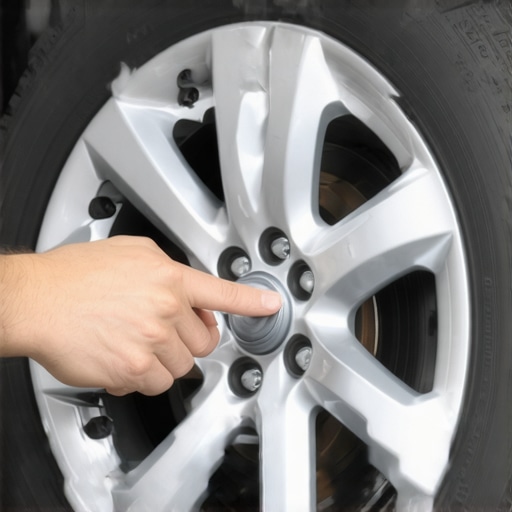
Distinguish Between the Shake and the Pulse
It is vital to know if the vibration is constant or if it only shows up when you try to slow down. If the steering wheel is calm until you touch the middle pedal, your tires are likely fine, but your brake rotors are warped. I once worked on a truck where the owner insisted on a full front-end rebuild, but the reason your steering wheel shakes only when you hit the brakes is almost always heat-warped metal rotors. When you press the pads against a wavy rotor, that vibration travels straight up the steering column and into your palms.
Give Your Wheel the Twelve and Six Test
If your tires look perfect and your weights are all there, it’s time to get the car off the ground. Jack up the front end (use jack stands for safety!) and grab a front tire at the 12 o’clock and 6 o’clock positions. Try to rock it back and forth. If there is any ‘play’ or clicking, you are looking at a mechanical failure. This is one of the top signs your car needs expert auto repair now because it usually points to a failing wheel bearing or a ball joint. You should also check the rubber boots on your axles; if they are torn and leaking grease, you need to know how to spot a bad cv joint before it snaps. A failing CV joint won’t just shake your car; it will eventually leave you stranded on the shoulder of the highway with a wheel that won’t turn. Follow these essential car service tips by checking for grease spray inside the wheel well, which is a dead giveaway that the axle’s protective boot has failed.Most shops will tell you that if your car is shaking, you need an alignment. I’m going to tell you they’re often wrong. Alignment deals with the angle of your tires relative to each other; high-speed vibration deals with the balance of the rotating mass. You can have a car that tracks perfectly straight but still shakes your fillings loose because of a heavy spot in the tire. This is the ‘alignment trap’ where you spend over a hundred dollars and leave the shop with the exact same problem. According to a report by the Car Care Council, over 70% of vehicles on the road have at least one under-inflated tire or an undiagnosed balance issue, yet shops frequently upsell alignments because they are high-margin services that don’t actually fix a centrifugal shimmy.
Why New Parts Don’t Always Fix the Shiver
The biggest ‘oops’ I see is the assumption that ‘new’ means ‘perfect.’ I once helped a buddy who bought brand-new tires specifically to stop a highway shimmy. The shake actually got worse. Why? Because the technician who mounted them didn’t calibrate his machine, or the tire had a manufacturing defect known as ‘radial force variation.’ If you’ve been chasing a ghost, remember that tires can wear unevenly even after an alignment if the internal structure is compromised. Sometimes, a ‘new’ tire has a shifted internal belt right out of the box. Have you ever fallen into this trap—throwing money at new parts only to have the problem persist? Let me know in the comments; I’ve been there, and it’s infuriating. We also need to talk about ‘electrical shakes.’ A subtle engine misfire can mimic a mechanical vibration so closely it fools seasoned pros. This is where regular tune-ups become more than just a suggestion. A failing coil pack or even the hidden ground strap that causes weird electrical ghosts can cause the engine to stumble under load—like when you’re cruising at 60 mph—making you think it’s a suspension issue when it’s actually an ignition one. #IMAGE_PLACE_HOLDER_C#
Can a Transmission Fault Mimic a Wheel Shake?
Advanced DIYers often ask if the torque converter is the secret culprit behind that 60 mph vibration. The answer is a frustrating ‘maybe.’ If the vibration feels like you’re driving over ‘rumble strips’ for just a few seconds when the car shifts into top gear, it might be torque converter shudder. This is a nuance most general shops miss, leading them to suggest how transmission overhauls save you money when you might actually just need a specific friction modifier fluid. Before you commit to a massive rebuild, verify if your transmission feels like it’s neutralizing or if the shake is strictly dependent on wheel speed. Lastly, don’t overlook the simple things. A buildup of dried mud or ice inside the rim can throw the balance off just as much as a missing weight. I’ve seen people pay for expert auto repair now when all they really needed was a high-pressure garden hose to clean out their wheels. Always look for the signs your ball joints are about to snap for safety first, but then check for the ‘dumb’ fixes before you open your wallet for a specialist.If you are tired of being at the mercy of a shop’s diagnostic fee, you need to invest in a decent OBD-II scanner with live data capabilities. I don’t mean the $10 plastic dongles; I mean something that can read transmission temperature and fuel trims in real-time. Why? Because as I mentioned earlier, a misfire can feel like a mechanical shake. When my old SUV started shuddering, I used a multimeter to find a parasitic battery drain that was messing with the ECU’s voltage, causing a rhythmic stumble. People often overlook the hidden ground strap that causes weird electrical ghosts, and without a meter, you are just throwing parts at a shadow. Most people assume a vibration is always a tire, but an engine that isn’t getting steady voltage can stagger just enough to mimic a wheel out of balance. 
How can I stay ahead of these repairs long-term?
The secret isn’t just fixing what breaks; it is knowing how to tell if your timing belt is about to snap or when to perform essential car service tips for safe summer drives. I have found that documenting every shimmy and sound in a logbook allows you to see patterns. If the shake only happens on cold mornings, you are looking at flat-spotting or why your transmission slips when the engine is cold. According to a technical bulletin from the Automotive Service Association (ASA), proactive maintenance can reduce emergency repair costs by up to 46% over the life of the vehicle. That is the difference between a $15 gasket and a $4,000 engine swap. To maintain a smooth ride over time, you need to ensure you maximize your car’s lifespan with regular tune-ups that include checking the integrity of your engine mounts. A collapsed rubber mount will transfer every single vibration from the motor directly into your seat, making even a perfect engine feel rough.
The Shift Toward Tech-Heavy Repairs
We are moving into an era where cars are more ‘computers on wheels’ than ever. I predict that in the next five years, basic mechanical DIY will shift almost entirely toward software calibration and sensor management. Even simple tasks like replacing a battery now require ‘registering’ the new unit with the car’s computer in many modern luxury brands. If you want to keep your car on the road without going broke, you have to learn the digital side alongside the grease. Before you go out and buy four new tires because of a highway tremor, do me a favor. Spend ten minutes performing the simple test to see if your shocks are actually blown. It costs zero dollars and might save you from an unnecessary bill for expert auto repair now. High-speed stability is a delicate balance of physics and maintenance; don’t let a small oversight turn into a permanent problem.
Lessons Bought with Sweat and Wasted Saturdays
After years of chasing vibrations, I have realized that the most expensive repair is often the one you did not actually need. Here are the core truths I wish I had known before I started wrenching in my own driveway:
- Balance Over Alignment: If the car shakes at speed but does not pull hard to one side, stop paying for alignments. It is almost always a balance issue or a structural tire defect.
- The Mud Factor: Always spray out your wheel wells with a high-pressure hose before heading to a mechanic. A hidden clump of dried clay can mimic a failing axle perfectly.
- Sound is Your Best Diagnostic Tool: Sometimes you do not need a hydraulic lift; you just need to listen closely. You can often diagnose a bad wheel bearing by sound alone before it becomes a legitimate safety hazard.
My Go-To Toolbox for Smooth Highway Cruising
You do not need a professional shop to get started, but you do need the right information and a few reliable tools. I never go on a long road trip without checking these essential car service tips for safe summer drives. My personal setup always includes a high-quality tire pressure gauge—because even a five PSI difference can cause resonance issues—and a basic OBD-II reader to check for those electrical shakes I mentioned earlier. If you are serious about DIY, invest in a torque wrench to ensure your lug nuts are tightened evenly; uneven torque can actually warp your rotors over time and create a pulsing sensation. #IMAGE_PLACEHOLDER_E#
Reclaim Your Peace of Mind at Sixty Miles Per Hour
Driving should be a relaxing experience, not a test of your nerves. When your car finally glides down the highway without a single tremor through the steering wheel, you will realize that the diagnostic effort was worth every second. Whether you choose to fix it yourself or decide it is finally time to look for expert auto repair now, taking immediate action prevents a small shimmy from becoming a total mechanical breakdown. Remember that you can maximize your car’s lifespan with regular tune-ups and a little bit of mechanical vigilance. Don’t let the fear of a big repair bill keep you off the road; most of the time, the solution is far simpler than a full transmission swap. Have you ever replaced a major part like a tire or axle only to have the shaking stay exactly the same? Let me know your experience in the comments below!